Mutual funds and SIP: the complete guide
Investing on autopilot
Figures checked 2026-10-17
Two ideas do most of the heavy lifting in everyday investing: the mutual fund, and the SIP (Systematic Investment Plan). Understand these two and you can start, even with ₹500 a month, without picking individual stocks or timing the market. This guide is the hub: it covers the essentials and links out to a deeper page on each big topic, so you can read what you need and skip the rest.
On this page: What a fund is · What an SIP is · What it costs · Risk · Returns · How to start · Keeping it on track · Redemption · Myths
Full deep-dive guides: Types of mutual funds · How mutual funds are taxed · How to pick a fund
What a mutual fund is
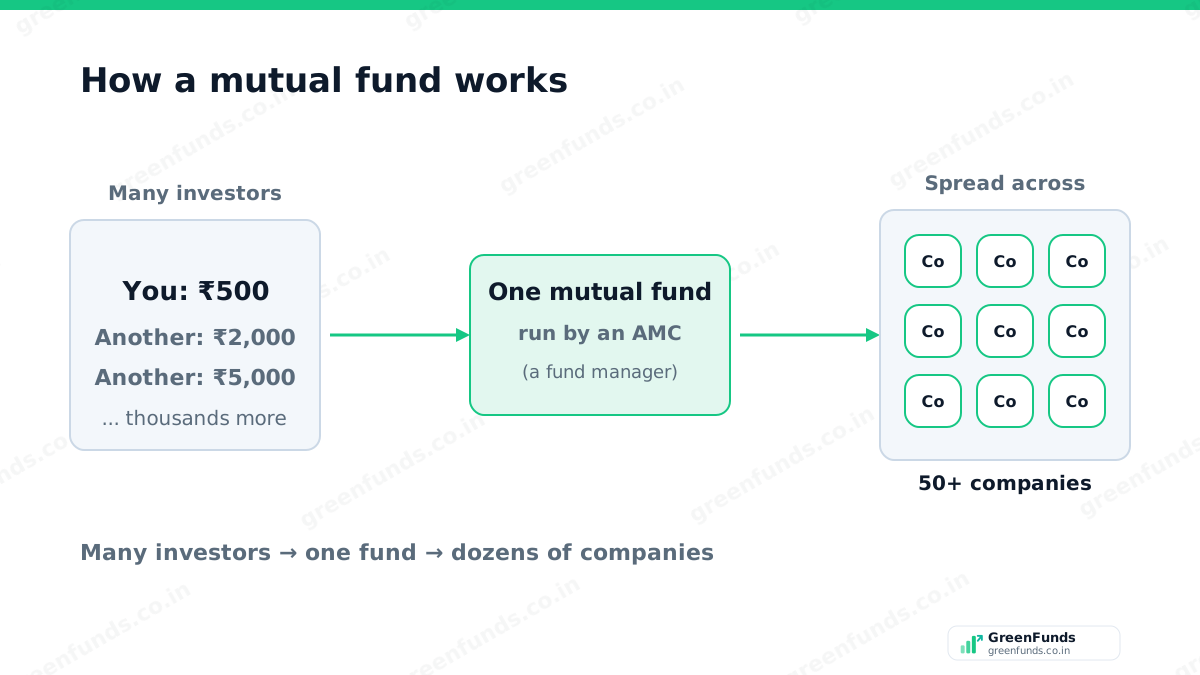
A mutual fund is a shared basket. Many people put money in, and a professional fund manager invests it together across many companies. Your ₹500 joins thousands of others, so even a small amount ends up spread across a wide set of shares instead of riding on one.
That spreading is the quiet magic. On your own, ₹500 buys a sliver of one company. Through a fund, the same ₹500 buys a tiny piece of dozens, so if one company stumbles, it barely dents you. You also rent the manager’s time and research instead of doing it all yourself.
Who actually runs your money
A fund is not one company doing everything. The structure is deliberately split so no single party holds both your money and the power to misuse it:
- AMC (Asset Management Company). The firm whose name is on the fund, for example an “XYZ Mutual Fund”. It employs the fund managers and makes the investment decisions.
- Trustee. A separate body that holds the fund in trust for you and polices the AMC on your behalf.
- Custodian. An independent institution that actually holds the shares and bonds the fund owns, kept apart from the AMC.
- RTA (Registrar and Transfer Agent). The record keeper that tracks your units, folios and transactions (names like CAMS and KFintech).
- SEBI (Securities and Exchange Board of India). The market regulator that writes and enforces the rules.
- AMFI (Association of Mutual Funds in India). The industry body behind investor awareness and shared standards.
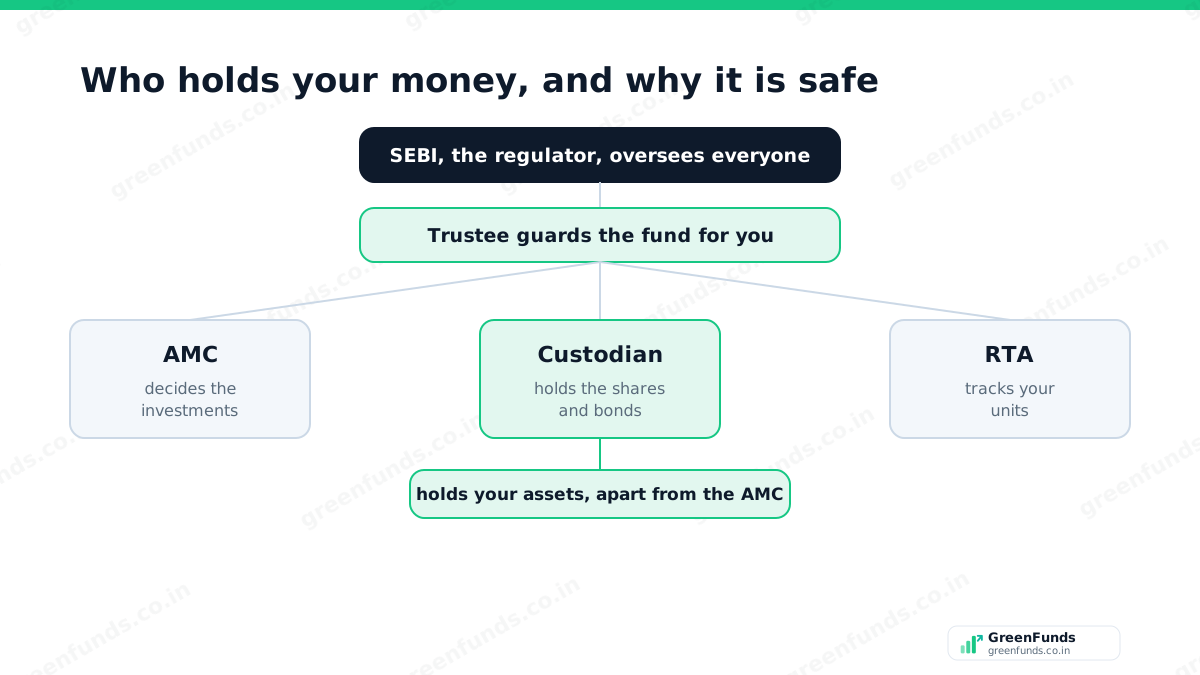
The practical takeaway: your units sit in a structure kept separate from the AMC, overseen by a trustee and SEBI. If a fund house exits the business, schemes are usually transferred or merged, not lost. What this structure does not remove is market risk, the plain fact that fund values rise and fall.
Units and NAV
When you invest, you don’t buy “a fund”. You buy units of it. The price of one unit is the NAV, short for Net Asset Value, worked out once each business day after markets close. In plain terms, NAV is the fund’s total holdings minus its costs, divided by the number of units.
Put ₹2,000 in at a NAV of ₹40 and you get 50 units. Next month the NAV might be ₹38, so the same ₹2,000 buys 52.63 units. You can hold fractions of a unit, so nothing is rounded away. Your holding is simply units multiplied by today’s NAV.
This matters because of a common confusion: a fund with a NAV of ₹15 is not cheaper than one at ₹450. You just get more units, each worth less. More on that trap in why a low NAV is not cheaper.
The types of mutual funds
In short, the main families are equity (mostly shares, higher growth with bigger swings), debt (mostly bonds, steadier), hybrid (a mix of both), and index funds and ETFs (passive, copying an index at low cost). The right family follows your goal and time frame, not last year’s winner.
For the full breakdown, every sub-type, and active versus passive investing, read the dedicated guide: types of mutual funds, explained.
What an SIP is
An SIP, or Systematic Investment Plan, is simply the habit of putting a fixed amount into a fund every month, automatically. You set it once and it runs on its own. If you have ever run a recurring deposit at a bank, the rhythm is the same; the difference is where the money goes, see recurring deposit vs SIP.
The rupee example. You set up an SIP of ₹2,000 on the 5th of every month. It happens whether the market is up, down, or sideways, with no decision required from you each time. To see how your own amount could grow, try the SIP calculator.
Why the automatic part matters
The value of an SIP is not just convenience. It quietly solves the hardest problem in investing: your own emotions.
It removes timing from your hands. Nobody reliably knows when the market is “low”. An SIP means you never have to guess. You buy a little every month, in good times and bad.
Rupee-cost averaging, in plain words. Because you invest a fixed rupee amount, your ₹2,000 buys more units when prices are low and fewer when prices are high. Over years, that pulls your average buying price down and smooths the ride. You are, almost by accident, buying more when it is cheap.
The catch, stated plainly: this smooths your entry price, it does not guarantee a gain. If the market is lower when you need the money than when you built the position, you will still be down. What protects you is the length of time you can leave it alone.
SIP versus lump sum
Monthly suits most salaried people, because it matches how income arrives and removes timing decisions. A lump sum can do better if you already hold the money and have a long horizon, because it is invested for longer. If you have a lump sum but are nervous, an STP (Systematic Transfer Plan) moves it gradually from a liquid fund into equity. The bigger mistake than either is waiting for a perfect entry point that never comes.
The date you buy is not always the date you are priced
A subtle point that confuses people: the NAV you get depends on SEBI cut-off times and when your money actually reaches the fund, not simply when you tapped “invest”. The detail is in your SIP date is not your NAV date.
What it costs
Fees are small numbers that compound into large ones, so they deserve real attention.
- Expense ratio (TER, the Total Expense Ratio). A yearly fee charged as a percentage of your money, deducted before the NAV is declared. You never see a bill; it is quietly taken out. On a 30-year plan, one percentage point of extra cost can cost lakhs. See what one percent a year really costs.
- Exit load. A charge some schemes apply if you redeem within a set period, often around a year. Hold past that window and it does not apply.
- Stamp duty. A tiny government charge on each purchase. Small enough to ignore in planning, but it exists.
- No entry load. India banned entry loads years ago, so no legitimate fund charges you to invest.
Direct versus regular, concretely
Every mutual fund has to offer two plans. Same scheme, same portfolio, same fund manager. The only difference is that a regular plan pays commission to whoever sold it to you, and a direct plan does not, so the direct plan carries a lower expense ratio and a slightly higher NAV over time.
If you pick funds yourself, direct leaves more money with you. If you genuinely use an adviser’s help, regular is what pays for it. What you should not do is hold a regular plan while getting no advice at all. More in same fund, two prices.
Growth or IDCW
Most schemes offer two options. Growth keeps every gain inside the scheme, so the NAV rises and compounding runs uninterrupted. IDCW (Income Distribution cum Capital Withdrawal) pays some of it out, and the NAV falls by exactly that amount on the payout date.
People sometimes read an IDCW payout as free money. It is not: that money came out of your own NAV. For a long-term goal, growth is usually the cleaner choice. The trap is explained in that payout came out of your own money.
Understanding risk
Risk is not one thing. The main kinds:
- Market risk: prices of shares and bonds fall. Equity has the most.
- Credit risk: a borrower in a debt fund fails to pay. Higher in credit risk funds.
- Interest-rate risk: bond prices fall when rates rise. Higher for long-duration debt funds.
- Liquidity risk: the fund struggles to sell holdings quickly in a crisis.
- Concentration risk: too much in one stock, sector or theme.
The riskometer and the risk numbers
Every scheme shows a riskometer, a dial with six levels from Low to Very High, so you can see at a glance how risky it is meant to be. Deeper measures include standard deviation (how much returns swing), beta (how much it moves with the market), and the Sharpe ratio (return earned for the risk taken). Most of these are voluntary disclosures. The one measure fund houses must publish daily is the information ratio, explained in the one risk number funds must publish.
Understanding returns
How a return is quoted changes what it means.
- Absolute return is the simple total gain, useful only for periods under a year.
- CAGR (Compound Annual Growth Rate) is the smoothed yearly rate over a multi-year period. Use this to compare funds over time.
- XIRR is the right measure for an SIP, because you invested on many different dates. It accounts for the timing of each instalment, which a simple average cannot.
Two honest reminders. Compare a fund against its benchmark, not against a fund in a different category. And what a fund did before doesn’t mean it will again: last year’s chart-topper is often an also-ran next year. For the engine underneath all of this, see compounding.
How mutual funds are taxed
In short: tax depends on whether the fund is equity or debt and how long you held it. Equity held longer gets a lower long-term rate above an annual exemption, debt is taxed at your income slab, ELSS funds give a Section 80C deduction with a three-year lock-in, and IDCW payouts are taxed at your slab. The rates changed in the 2024 Budget and move with every Budget, so always verify the current figures.
For the full picture, holding periods, how an SIP is taxed and the IDCW catch, read the dedicated guide: how mutual funds are taxed.
How to pick a fund
The short version: start with your goal and time frame, match the fund category to it, keep costs low (a direct plan with a low expense ratio), look for consistent performance against the benchmark rather than one hot year, and keep the number of funds small. Fit beats last year’s chart.
For the full framework, the red flags to avoid and a checklist, read the dedicated guide: how to pick a mutual fund.
How to actually start
- Complete your KYC (Know Your Customer) once, with PAN and Aadhaar. It carries across fund houses. You do not need a demat account for regular mutual funds (only for ETFs).
- Choose where to invest: directly on the AMC’s site, through an RTA platform (CAMS or KFintech), or a reputable app. For the lowest cost, pick the direct plan.
- Pick a scheme that matches your horizon.
- Set the SIP date a day or two after payday, so the money leaves before you can spend it.
- Set up the mandate so it runs without a monthly approval, then leave it alone.
Raise it as you earn more
A ₹2,000 SIP set at 24 and never touched is still ₹2,000 at 34, by which point it is a much smaller share of your income. A step-up SIP raises the amount automatically each year. Even a 10 percent annual increase changes the end result substantially, and you barely feel it because it tracks your raises.
Keeping it on track
Investing is not fully “set and forget”, but it is close.
- Review once or twice a year, not daily. Check that your mix still matches your goals.
- Rebalance occasionally if one part has grown far out of proportion.
- Switching funds is a sale and a fresh purchase, so it can trigger exit load and tax. Switch for a real reason, not boredom.
- SWP (Systematic Withdrawal Plan) is the reverse of an SIP: it pays you a fixed amount every month from your investment, useful in retirement.
Redemption: getting your money out
When you redeem, the price you get again depends on cut-off times, and the money reaches your bank after a settlement period (often a day or two for equity, faster for liquid funds). Some liquid funds offer instant redemption up to a capped amount, covered in same-day money from liquid funds.
In rare, market-wide crises a fund can briefly restrict redemptions, within strict limits that protect small investors first, explained in when a fund can pause your withdrawal.
Special situations worth knowing
- NFO (New Fund Offer). A fund’s launch period, when units are offered at ₹10. This is not a discount or an IPO-style opportunity; a ₹10 NAV is not “cheap”. Judge an NFO on its strategy, not its price.
- Side-pocketing. When a bond in a debt fund goes bad, the fund can wall it off so exiting investors cannot dump the loss on those who stay. See what happens when a bond defaults.
- Scheme mergers and AMC exits. Schemes get merged or transferred; your units are not wiped out by an AMC leaving the business, because of the separate custodian and trustee structure.
Myths and common mistakes
- “A low NAV fund is cheaper.” No. It only means more units, each worth less.
- “An IDCW payout is extra income.” No. It comes out of your own NAV.
- Stopping the SIP when markets fall. Those are the months your money buys the most units.
- Chasing last year’s top fund, and paying for it in fees and tax.
- Holding a regular plan while taking no advice.
- Running six similar funds and calling it diversification.
- Judging progress after a year or two. The curve barely moves early; that is the design, not a failure.
Putting it together
Start small, keep it automatic, pick a simple low-cost fund that matches your goal, and let time and compounding do the work. An SIP of an amount you will not miss, left alone for years, is one of the most reliable ways an ordinary person builds wealth, precisely because it needs so little cleverness.
Ready to act? See how to actually start, or browse the money basics path. Prefer Hinglish? Read mutual fund kya hai.
Questions people ask
What's the minimum amount needed to start an SIP?
Many schemes start at ₹500 a month, and some go lower. The amount matters less than the habit. Start with something you won't be tempted to cancel in a tight month, and raise it when your income rises.
What's the difference between a direct plan and a regular plan?
Same scheme, same portfolio, same manager. A direct plan cuts out distributor commission, so it carries a lower expense ratio and leaves more with you. A regular plan pays for advice and service. If you're choosing on your own, direct costs less.
Does an SIP guarantee a profit?
No. An SIP (Systematic Investment Plan) is a way of investing, not a type of return. It spreads your entry across many price points, which smooths the ride, but if the whole market is lower when you need the money, you can still be down. Time horizon is what protects you.
Growth option or IDCW, which should I pick?
Growth keeps gains inside the scheme, so your NAV rises and compounding runs undisturbed. IDCW (Income Distribution cum Capital Withdrawal) pays some of it out, and the NAV drops by that amount on the payout date. For a long-term goal, growth is usually the simpler choice.
What is an expense ratio and why does it matter?
It's the yearly fee charged as a percentage of your money, deducted before the NAV is declared. It sounds trivial and compounds heavily. On a 30-year plan, one percentage point of extra cost can run into lakhs, so it deserves real attention.
Can I stop or pause an SIP?
Yes. You can pause, reduce, or stop an open-ended SIP without penalty. There may still be an exit load if you redeem units within the scheme's stated period. Stopping during a market fall is the common mistake, because those are the months your money buys the most units.
SIP or lump sum, which is better?
Monthly suits most salaried people, because it matches how income arrives and removes timing decisions. A lump sum can work if you already hold the money and have a long horizon. Waiting for the perfect entry point usually costs more than either choice.
What is a step-up SIP?
An SIP that rises automatically each year, often by a fixed percentage. It keeps your investing in step with your salary instead of frozen at whatever you could afford when you started. Small annual increases make a large difference over decades.
Index fund or an actively managed fund?
An index fund just copies a market index at a very low cost. An active fund pays a manager to try to beat the index, at a higher cost, and many do not beat it after fees over the long run. For most beginners a low-cost index fund is a sensible default, but both are valid.
How are mutual funds taxed?
It depends on whether the fund is equity or debt and how long you hold it, and the rules changed in the 2024 Budget. As a structure: equity funds have a lower long-term rate above an annual exemption, debt funds are taxed at your income slab, and ELSS funds give an 80C deduction with a lock-in. Always verify the current rates on incometax.gov.in before you act.
Is my money safe if the fund house shuts down?
Your units are held in a structure kept separate from the Asset Management Company. The shares and bonds are held by an independent custodian and the fund is overseen by a trustee and SEBI. If an AMC exits, schemes are typically transferred or merged, not lost. Market falls can still reduce your value; that is a different risk.
Flag a possible issue
Sources
- SEBI, Mutual Funds investor section Scheme categories, disclosures, and investor rules. Verify current rules here.
- AMFI (Association of Mutual Funds in India) Industry data, SIP inflows, and the investor awareness resources.
- Income Tax Department, Government of India Capital gains and 80C rules. Tax figures change with each Budget, so confirm the current year here.