Your credit score, explained: the number behind every loan
A higher score means cheaper credit
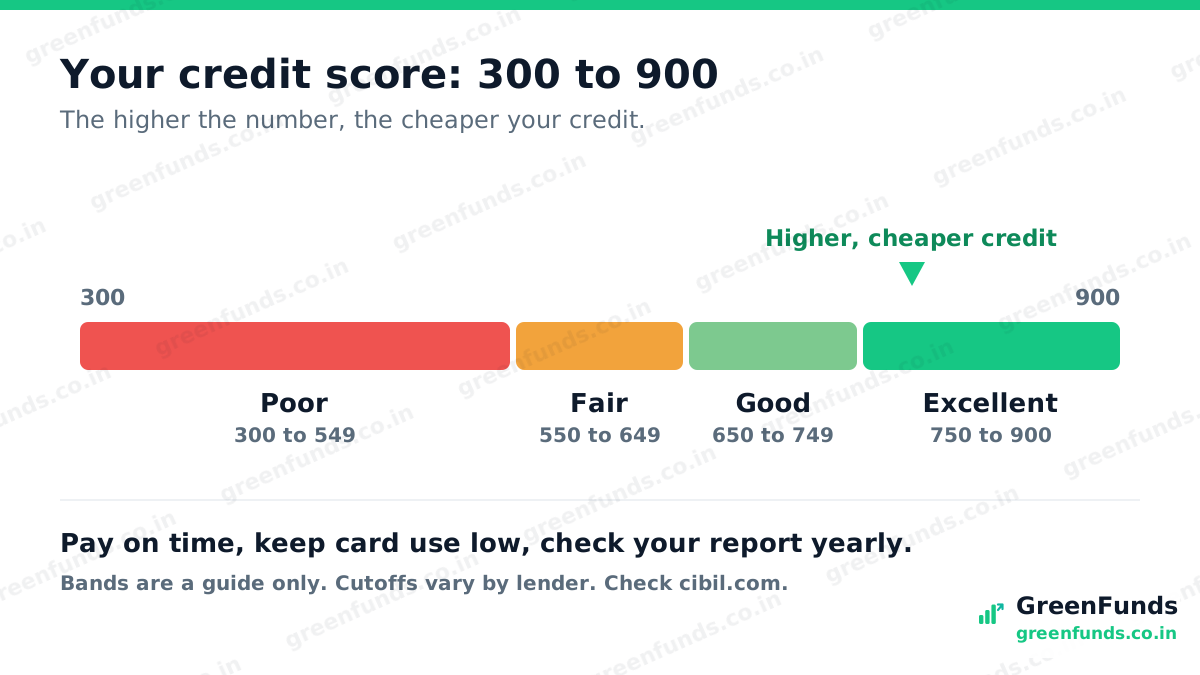
What it is. Your credit score is a three digit number, from 300 to 900, that lenders check before they give you a loan or a credit card. Credit bureaus build it from your repayment record. CIBIL is the best known, and Experian, Equifax and CRIF High Mark keep their own. A higher number tells a lender you repay on time. CIBIL does not publish its exact formula, so treat any precise “weightage” you see online as an estimate.
Why it matters to you. A strong score does two things: it makes approval easier, and it can get you a lower interest rate. A weak score can mean a flat rejection, or a loan that costs you more every month for years.
What a lower rate is worth. Rate is where the score pays off. Take a ₹5 lakh personal loan over five years. At 14% a year the EMI is about ₹11,600 a month. At 18% it is about ₹12,700. That is roughly ₹60,000 more over the loan, for the exact same borrowing. The better your score, the better the rate a lender is likely to offer. Illustration only; your actual rate depends on the lender.
Where your score sits: the bands. Bureaus do not publish official category names, but lenders and apps commonly split the 300 to 900 scale into four rough bands. They are a guide, not a rule, and every lender sets its own cutoff.
| Score range | Common label | What it usually means for you |
|---|---|---|
| 300 to 549 | Poor | Approval is hard; expect rejections or a high rate |
| 550 to 649 | Fair | Some lenders may say yes, often at a steeper rate |
| 650 to 749 | Good | Most lenders will consider you on normal terms |
| 750 to 900 | Excellent | Easiest approval and the lowest rates on offer |
A brand new borrower has no score at all, shown as NA or NH (not applicable, or no history), not a low 300. No history is not the same as a bad record. These bands are a widely used convention, not an official CIBIL standard, so confirm your own band on the bureau’s site.
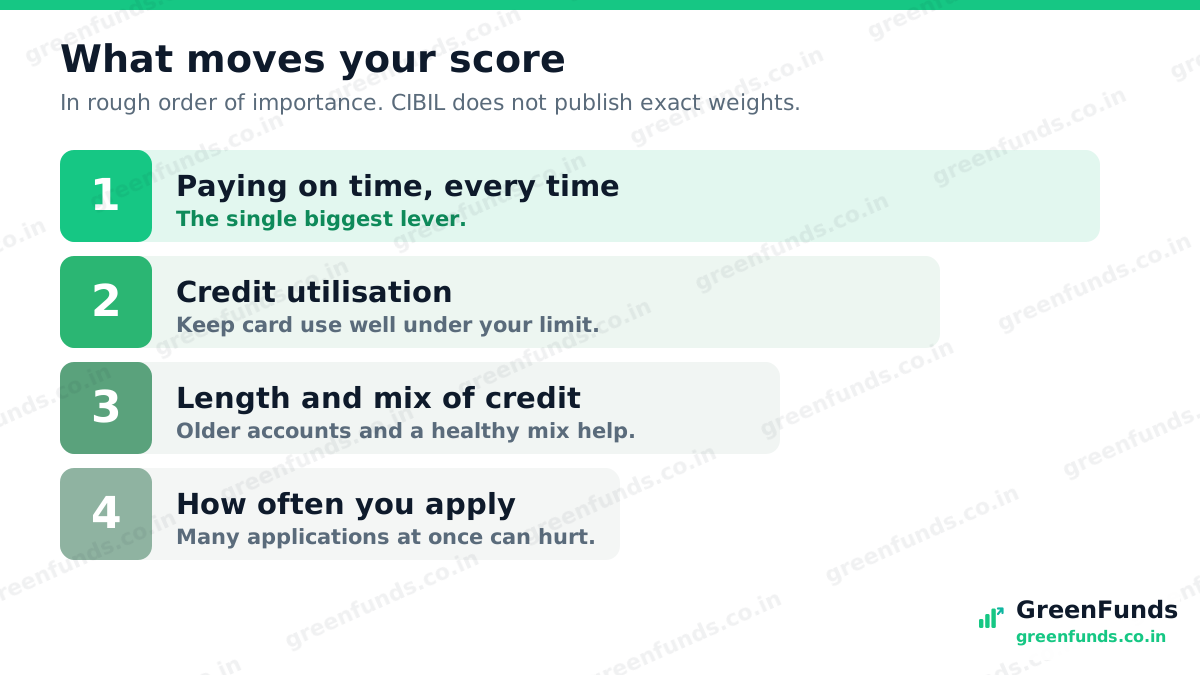
What moves your score. In rough order of importance:
- Paying on time, every time. This is the single biggest lever. One missed card or EMI payment can pull your score down fast.
- Credit utilisation. How much of your card limit you use. Keeping it low, well under the limit, helps.
- A long, healthy history. Older accounts and a sensible mix of credit count in your favour.
- How often you apply. Many loan or card applications in a short time can each leave a mark and dent the score.
CIBIL keeps the exact weights private, so think of these as levers, not a formula.
A good score, roughly. Many lenders treat a higher score, often around 750 and above, as strong. But there is no single official cutoff, and it varies by lender and product. Aim high rather than at a magic number.
Checking your own score does not hurt it. When you check your own score it is a soft enquiry and changes nothing. Only a hard enquiry, when a lender checks because you applied, can nudge it. So check yours often.
How to see yours, free. RBI has required each credit bureau to give you one free full credit report a year, and many banks and apps show a score for free too. Pull your report, read it, and if you spot a loan or default that is not yours, raise a dispute with the bureau. Errors are common, and they cost you. Confirm the current free-report process on the bureau’s own site.
The habits that build it. Pay your full card bill by the due date, not just the minimum due. Keep your card usage low. Do not chase every new card offer. Keep your oldest account open. And check your report once a year. The same habit that keeps you out of the credit card trap is the one that lifts your score.
New to borrowing? Start with good debt vs bad debt.
Questions people ask
What is a credit score?
A three digit number from 300 to 900 that lenders check before giving you a loan or card. Credit bureaus like CIBIL build it from your repayment record. A higher number signals that you repay on time.
What is a good CIBIL score, and what are the ranges?
There is no single official cutoff. Lenders and apps commonly read the 300 to 900 scale as four rough bands: 300 to 549 poor, 550 to 649 fair, 650 to 749 good, and 750 to 900 excellent. Many treat a score around 750 and above as strong, but it varies by lender and by the product you apply for. Aim as high as you can rather than at one magic number.
How can I check my credit score for free?
RBI has required each credit bureau to give one free full credit report a year, and many banks and apps show a score for free. Check the bureau's own site for the current process, and review the report for errors.
Does checking my own credit score lower it?
No. Checking your own score is a soft enquiry and does not affect it. Only a hard enquiry, when a lender checks because you applied for credit, can nudge your score.
What hurts my credit score the most?
Missing payments is the biggest factor. Heavy use of your card limit, many loan or card applications in a short time, and a very short history can also pull it down. CIBIL does not publish exact weights, so treat these as levers.
How long does it take to improve a credit score?
There is no fixed timeline. Paying on time and keeping your card usage low over several months usually helps, but it is gradual. There is no quick fix, and anyone promising an instant jump for a fee is best avoided.
Is a credit score of 750 or above good?
Yes. A score from about 750 up to the maximum of 900 sits in what lenders often call the excellent band, and tends to unlock the easiest approvals and the best rates. There is no single official cutoff, so each lender decides, but within the 300 to 900 scale, higher is always better.
Source: Credit bureaus (CIBIL, Experian, Equifax, CRIF High Mark) and RBI rules. CIBIL's exact formula is not public, so check cibil.com.
Found this useful? You can buy us a coffee. It keeps GreenFunds free.Flag a possible issue
Was this helpful?
Thanks for the signal.
Comments
Share your experience or a question. Be kind, stay on topic. This is reader discussion, not financial advice.
No comments yet. Be the first to share.