How to read a company's annual report: a beginner's guide
An annual report tells you whether a company's profit is real, how much it owes and what its auditor thinks
An annual report is the one document where a listed company has to show its full-year accounts, explain its business and print what its auditor thinks. It can run to hundreds of pages, but you do not need to read all of it. A few sections, and three simple checks, tell you most of what a beginner needs.
Where to find it
Under SEBI’s listing rules (regulation 34 of the LODR Regulations, 2015), a listed company must send its annual report to the stock exchange and publish it on its own website, on or before the day it starts sending it to shareholders. So you can download it from:
- the company’s website, usually under “Investors” or “Investor relations”
- the company’s filings page on NSE or BSE
The parts that matter
SEBI’s rules list what the report must contain: audited financial statements, consolidated statements, a cash flow statement, a directors’ report and a management discussion and analysis. The Companies Act, 2013 adds more.
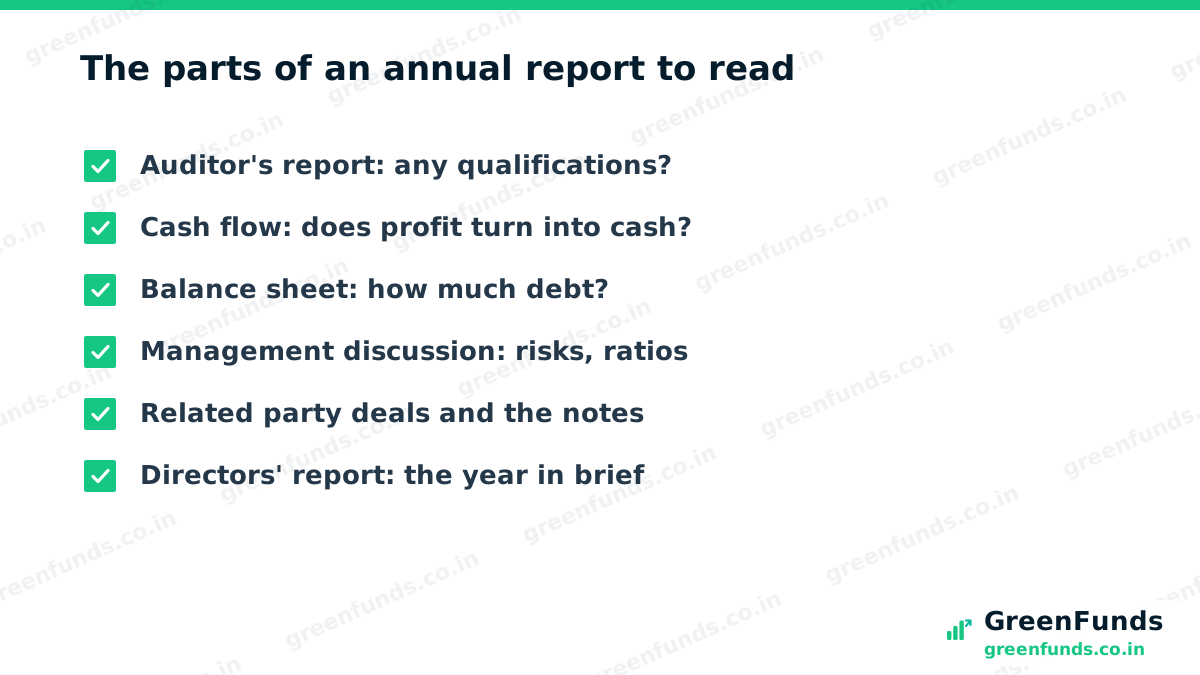
- Auditor’s report. Look for a heading such as “Basis for qualified opinion”. SEBI calls a report with reservations a modified opinion, and the company must file a statement on the impact of those qualifications with its yearly results.
- Profit and loss statement. Sales, costs and profit for the year.
- Balance sheet. What the company owns and what it owes on the last day of the year.
- Cash flow statement. The cash that actually came in and went out. Profit can be bent by accounting choices; cash is harder to fake.
- Management discussion and analysis. The industry, risks and outlook. Under Schedule V, the company must explain any key ratio, such as debt to equity or net profit margin, that changed by 25% or more from the year before.
- Related party transactions. Deals with promoters, directors and group firms. SEBI requires audit committee approval for these, and shareholder approval for material ones.
- Notes to accounts. The fine print behind each number: loans, pending lawsuits and changes in accounting policy.
- Directors’ report. The board’s summary of the year, including the dividend it recommends. The top 1,000 listed companies must also give a link to their dividend distribution policy in the annual report.
Three simple checks, worked through
An illustration, with made-up numbers. Say a company has borrowings of 300 crore rupees and shareholders’ equity of 600 crore.
1. Debt to equity. 300 divided by 600 is 0.5. The company owes 50 paise for every rupee its owners have put in or kept as profit. Track it over five years and against similar companies, not on its own.
2. Can it pay its interest? Its profit before interest and tax is 200 crore and its interest bill is 25 crore. 200 divided by 25 is 8, so profit covers interest eight times over. A figure that keeps falling is a warning sign.
3. Is profit turning into cash? Compare profit with cash from operations, from the cash flow statement.
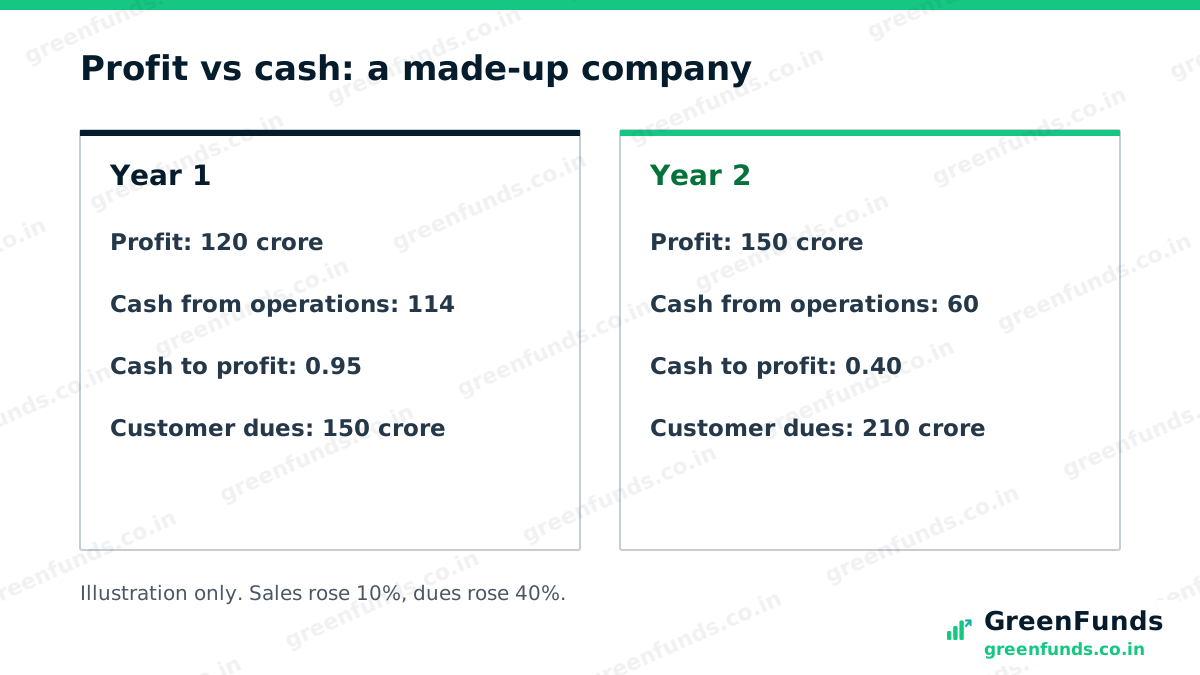
In year 1, profit was 120 crore and operating cash was 114 crore, a ratio of 0.95. In year 2, profit rose 25% to 150 crore, but operating cash fell to 60 crore, a ratio of 0.40. The reason sits in the balance sheet: sales grew 10%, from 1,000 crore to 1,100 crore, but money owed by customers grew 40%, from 150 crore to 210 crore. That is about 70 days of sales waiting to be collected, up from about 55. Profit that does not arrive as cash is worth asking about.
Did you know? SEBI’s rules require a listed company to file its annual report with the exchange no later than the day it starts sending it to shareholders. Ordinary investors can read it at the same time as everyone else, for free.
What an annual report will not tell you
It looks backwards, and it is written by the company. It does not tell you whether the share price is cheap or dear. For that you need to compare price with earnings, explained in P/E ratio and valuation basics, and see the P/E ratio entry. Once you own shares, the dividend the report recommends reaches you only if you hold them on the record date, explained in record date vs ex-date.
The takeaway. Read the auditor’s report first, put profit next to cash, and check how much the company owes. Three ratios and a careful look at related party deals will tell you more than the glossy pages at the front.
More to read: what the stock market is, how share prices move, how to buy your first share, stock split, bonus and buyback, large, mid and small cap, and, if you want to work in fund distribution, the NISM V-A topics that trip people up.
Questions people ask
Where can I find a company's annual report?
On the company's own website, usually under an investor relations section, and in its filings on the stock exchanges, NSE and BSE. SEBI's listing rules require a listed company to send the annual report to the exchange and publish it on its website, on or before the day it starts sending it to shareholders.
Which part of an annual report should a beginner read first?
Start with the auditor's report, to see whether the auditor has any qualification or reservation about the accounts. Then read the cash flow statement next to the profit and loss statement, to check that profit is turning into cash. After that, the balance sheet shows how much the company owes.
What is a qualified audit opinion?
It means the auditor could not fully agree with some part of the accounts and has said so. SEBI calls this a modified opinion, and a listed company must file a statement on the impact of audit qualifications with its yearly results. A clean report is called an unmodified opinion.
What is a good debt to equity ratio?
There is no single good number, because a bank, a power company and a software company carry very different levels of debt. Debt to equity is total borrowings divided by shareholders' equity. It is most useful when you compare one company over several years, or with others in the same industry.
What are related party transactions in an annual report?
Deals between the company and people or firms connected to it, such as promoters, directors or group companies. SEBI requires audit committee approval for these deals and shareholder approval for material ones, and the annual report discloses them. Large or growing deals with related parties deserve a closer look.
Source: SEBI (Listing Obligations and Disclosure Requirements) Regulations, 2015, last amended on 15 October 2026 (sebi.gov.in): regulation 34 (annual report contents and filing), regulation 33(3)(d) (statement on impact of audit qualifications), regulation 23 (related party transactions), regulation 43A (dividend distribution policy) and Schedule V, Part B (management discussion and analysis, including key ratio changes of 25% or more). Worked example uses made-up numbers.
Found this useful? You can buy us a coffee. It keeps GreenFunds free.Flag a possible issue
Was this helpful?
Thanks for the signal.
Comments
Share your experience or a question. Be kind, stay on topic. This is reader discussion, not financial advice.
No comments yet. Be the first to share.