What is an index fund, and why beginners start there
A fund that copies a whole market index
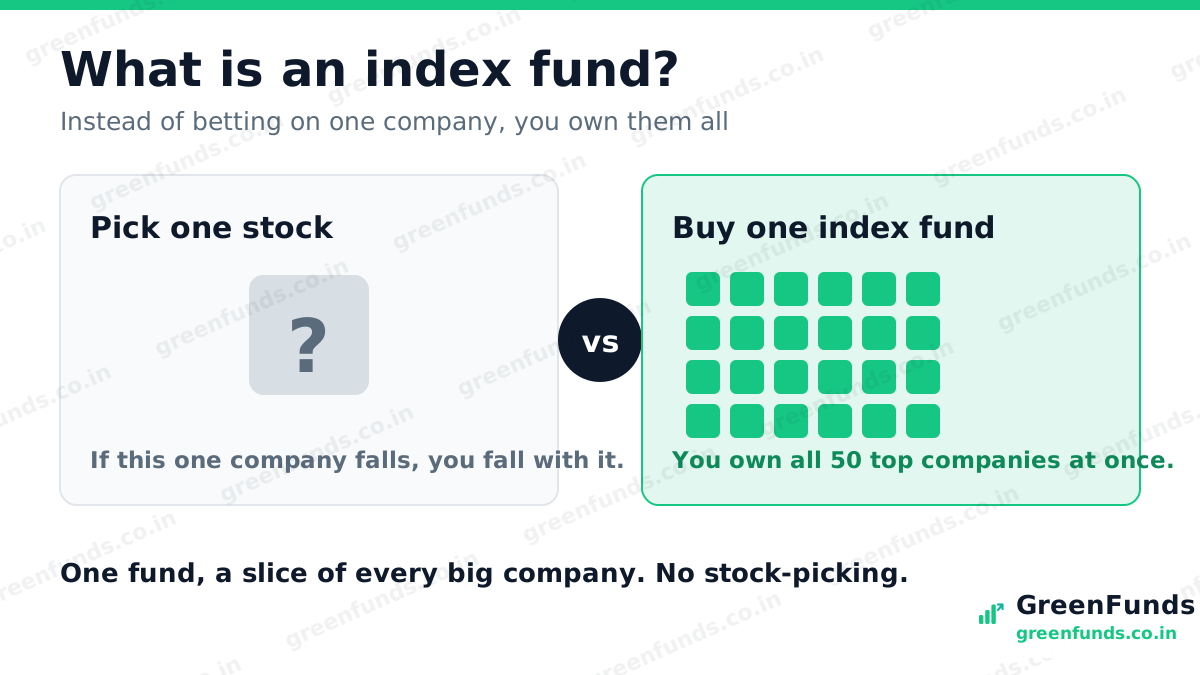
What it is. An index fund is a mutual fund that simply copies the whole market instead of trying to beat it. A “market index” is just a ready-made list of the biggest companies, like the Nifty 50 (India’s 50 largest) or the Sensex (30). The fund buys those same companies in the same proportion, so no manager picks stocks; it just tracks the market.
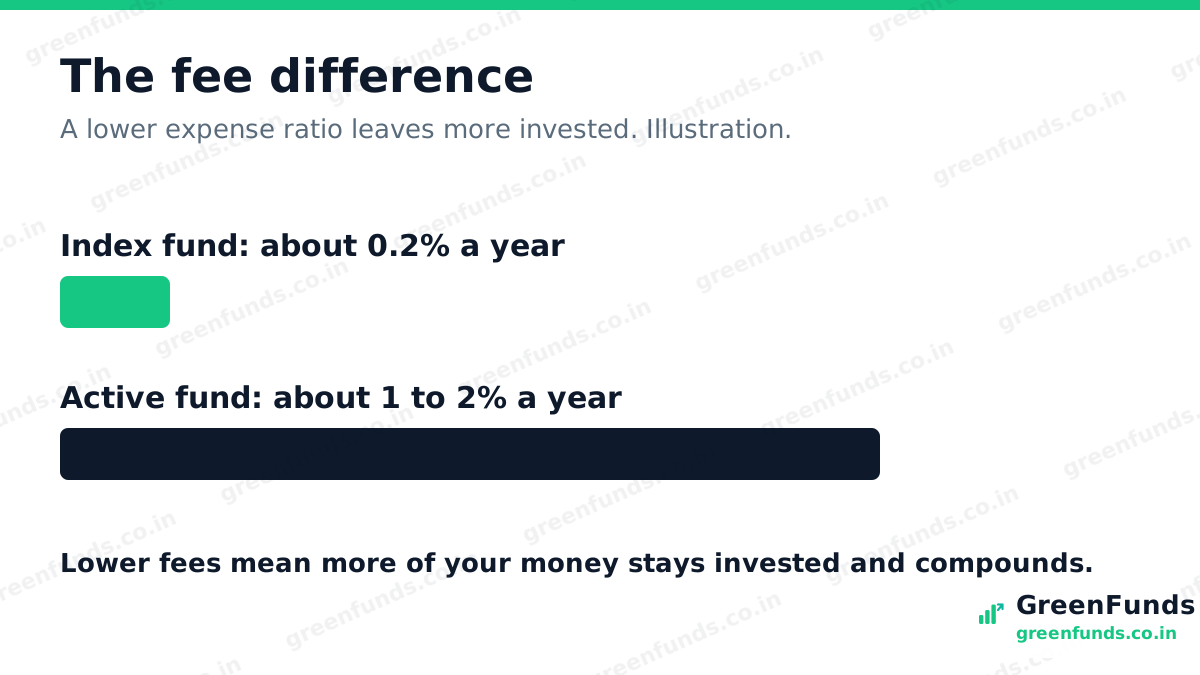
Why beginners start here. Three reasons. One, it is cheap: with no manager picking stocks, the fee, called the expense ratio, is low, often around 0.2% a year, against roughly 1 to 2% for an active fund. Two, you get instant diversification: one fund spreads your money across many companies at once, so no single company sinks you. Three, no guessing: you are not trying to pick winners, you ride the whole market.
Did you know? Even the professionals mostly fail to beat the market. Over the five years to the end of 2024, about 93 out of every 100 actively managed large-cap funds in India did worse than their benchmark index (S&P Dow Jones Indices SPIVA India Scorecard, year-end 2024). These figures are published afresh each year, so check the latest, but the long-run pattern is steady: paying someone to beat the market usually does not pay off.
The fee adds up. A lower expense ratio means more of your money stays invested and compounds. Over years, the gap between 0.2% and 1.5% a year is large. The exact fees vary, so check each fund’s factsheet.
The honest part. An index fund matches the market, it does not beat it. When the market falls, your fund falls too. It is a simple, low-cost way to invest, not a way to avoid risk.
How to start. You can start an index fund through any mutual fund app, often as a SIP, with as little as ₹500 a month.
New to investing? Start on the learn page.
Questions people ask
What is an index fund?
A mutual fund that copies a market index like the Nifty 50, buying the same companies in the same proportion. No manager picks stocks; it just tracks the market.
Are index funds good for beginners?
They are popular with beginners because they are low-cost, spread your money across many companies, and need no stock-picking. But they still carry market risk and fall when the market falls.
What is the expense ratio of an index fund?
Often around 0.2% a year, much lower than the 1 to 2% many active funds charge. The lower fee leaves more of your money invested. Check each fund's factsheet for the exact number.
Do index funds beat the market?
No. An index fund is built to match its index, not beat it, minus a small fee. That simplicity and low cost are the point.
Source: General investing education; active-vs-passive figures from the S&P Dow Jones Indices SPIVA India Scorecard. Check each fund's factsheet for its actual expense ratio, and the latest scorecard for current figures.
Found this useful? You can buy us a coffee. It keeps GreenFunds free.Flag a possible issue
Was this helpful?
Thanks for the signal.
Comments
Share your experience or a question. Be kind, stay on topic. This is reader discussion, not financial advice.
No comments yet. Be the first to share.