Which ITR form should you file? ITR-1, ITR-2, ITR-3 or ITR-4
Your income sources, not your salary size alone, decide which ITR form you use
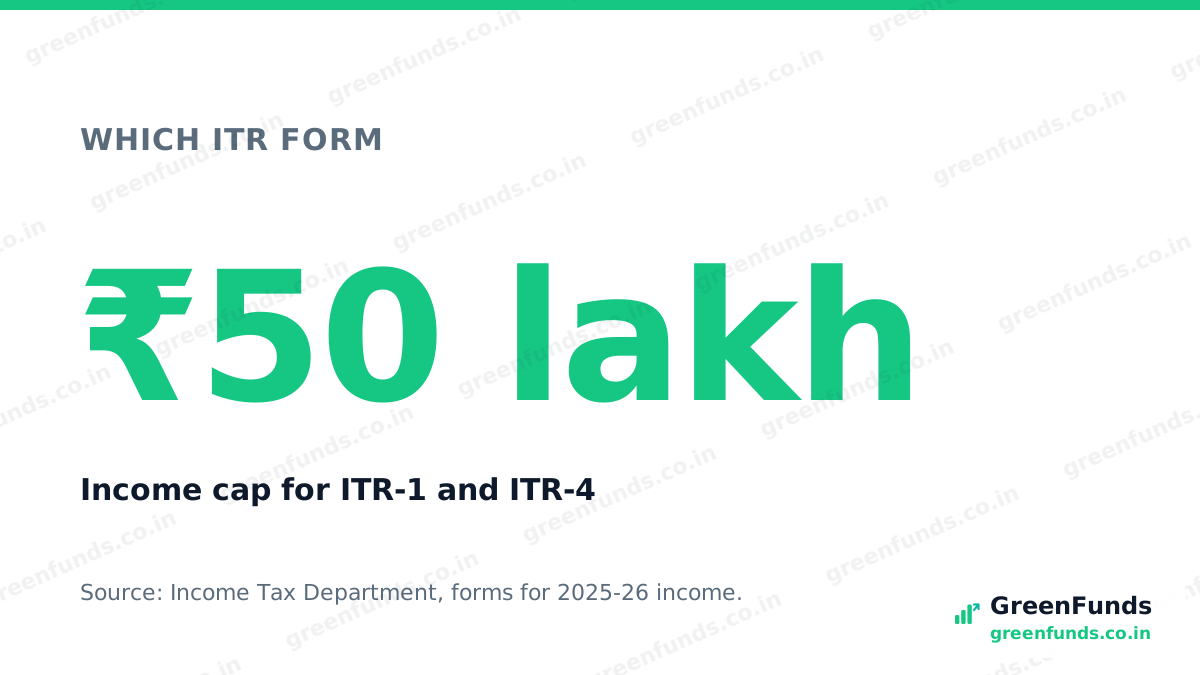
The ITR form you choose depends on where your money came from, not on how big your salary is. Pick one you are not eligible for and the department can treat the return as defective, which means an income tax notice and a fix within 15 days.
Which year this covers. The latest forms the Central Board of Direct Taxes (CBDT) has notified are for assessment year 2026-27, which means income earned from April 2025 to March 2026. They were notified on 30 March 2026 under the old 1961 law, because that income still falls under it. Income earned from April 2026 is tax year 2026-27 under the new Income-tax Act, and will be filed in 2027 on forms made under the new rules. The rules below are for the 2025-26 income.
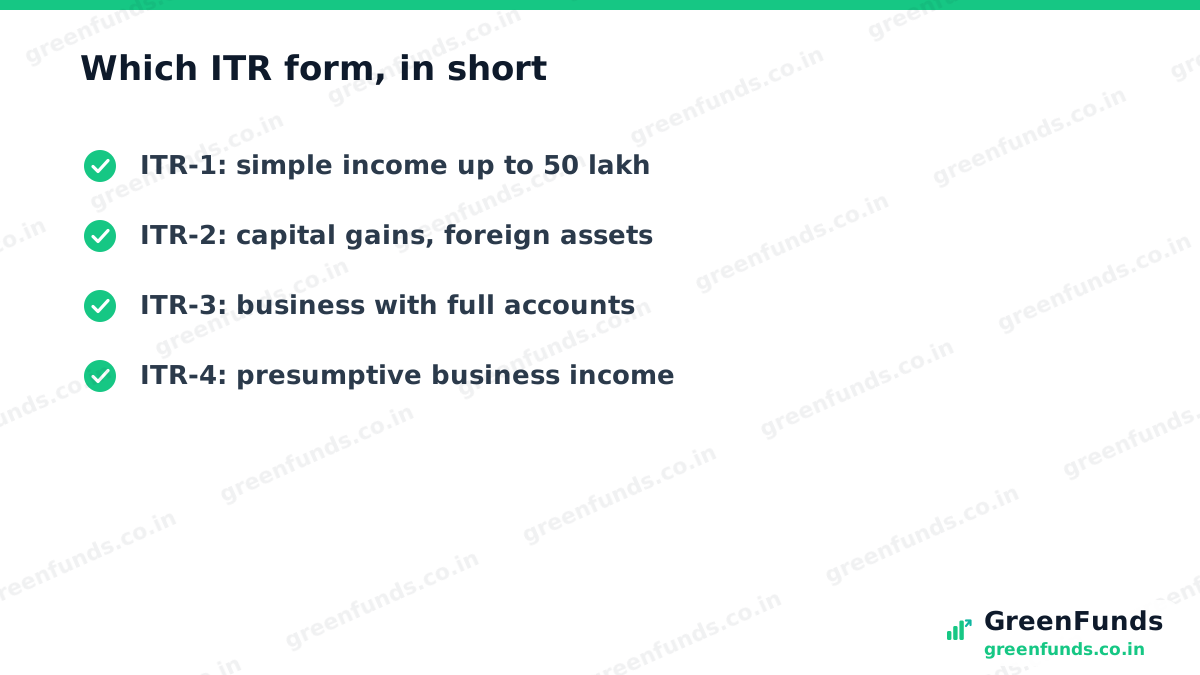
ITR-1 (Sahaj): the short form
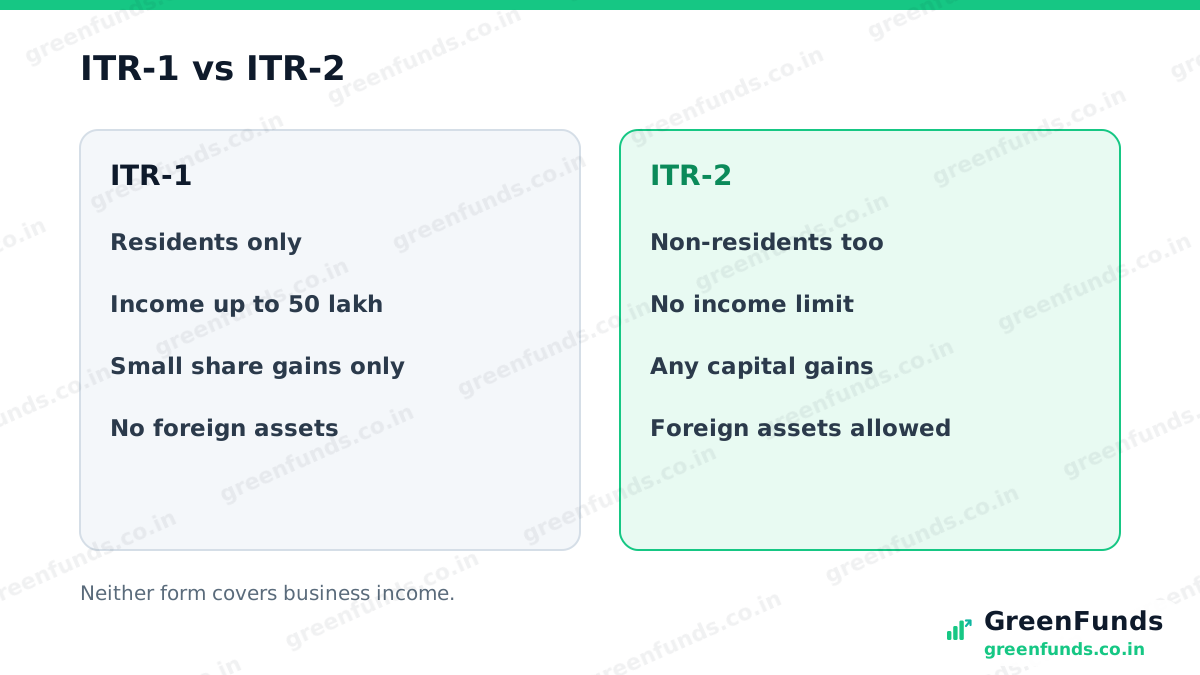
For a resident individual, not “not ordinarily resident”, with total income up to 50 lakh rupees, from:
- salary or pension
- up to two house properties (new for this year; earlier forms allowed one)
- other sources, such as interest, family pension and dividends
- agricultural income up to 5,000 rupees
- long-term capital gains on listed shares and equity funds, under section 112A, up to 1.25 lakh rupees
You cannot use ITR-1 if you are a company director, held unlisted equity shares at any time in the year, have any asset or income outside India or signing authority in a foreign account, have any short-term capital gain, have losses to carry forward, or have deferred tax on employee stock options.
ITR-2: capital gains and more
For individuals and Hindu undivided families (HUFs) with no business or professional income who cannot use ITR-1. Common reasons: short-term capital gains, long-term gains above 1.25 lakh rupees, foreign assets or income, a directorship, unlisted shares, more than two house properties, total income above 50 lakh rupees, or being a non-resident.
ITR-3 and ITR-4: if you run a business or profession
ITR-4 (Sugam) is for resident individuals, HUFs and firms other than LLPs whose business or professional income is computed under the presumptive taxation scheme (sections 44AD, 44ADA and 44AE of the 1961 Act). Total income must be up to 50 lakh rupees, and the same exclusions as ITR-1 apply. It is optional.
ITR-3 is for individuals and HUFs with business or professional income who cannot use ITR-4, for example because they keep full accounts or earn above 50 lakh rupees. It can also report salary, house property, capital gains and other income.
An illustration. Asha earns a salary of 14 lakh rupees and sold equity fund units held for two years at a 90,000 rupee gain. That gain is under 1.25 lakh, so ITR-1 works. If she had also sold shares held for eight months at a 20,000 rupee profit, that short-term gain moves her to ITR-2. If she instead had freelance design income taxed under the presumptive scheme, she would look at ITR-4. (Made-up numbers.)
Did you know? Your AIS often decides the form for you. If it shows a share sale, foreign dividend or unlisted share you had forgotten, the simple form may no longer fit. Check AIS and Form 26AS before you choose.
Missed the July deadline?
The due date for most people for 2025-26 income was 31 July 2026. You can still file a belated return until 31 December 2026, with a late fee of 5,000 rupees, or 1,000 rupees if total income is up to 5 lakh rupees. Steps are in how to file your income tax return.
The takeaway. Start with ITR-1 and look for a reason you cannot use it: capital gains beyond the limit, anything foreign, a directorship, unlisted shares, business income, or income above 50 lakh rupees. Each one points you to ITR-2, ITR-3 or ITR-4.
More to read: what to do if you get an income tax notice, Form 16, decoded, old vs new tax regime, and how capital gains are taxed.
Questions people ask
Which ITR form should a salaried person file?
Most salaried people can use ITR-1 (Sahaj) if they are resident, their total income is up to 50 lakh rupees, and their income is only salary or pension, up to two house properties, interest and similar other income, and long-term gains on listed shares or equity funds up to 1.25 lakh rupees. Any short-term capital gain, foreign asset, directorship or unlisted shares moves you to ITR-2.
What is the difference between ITR-1 and ITR-2?
ITR-1 is the short form for simple income up to 50 lakh rupees. ITR-2 is for individuals and Hindu undivided families with no business income who cannot use ITR-1, for example because of short-term capital gains, larger long-term gains, foreign assets or income, being a company director, holding unlisted shares, or income above 50 lakh rupees.
Who can file ITR-4?
ITR-4 (Sugam) is for resident individuals, Hindu undivided families and firms other than LLPs whose business or professional income is worked out under the presumptive scheme, with total income up to 50 lakh rupees. The same exclusions as ITR-1 apply, such as foreign assets or being a company director. Using it is optional.
When should I use ITR-3?
Use ITR-3 if you are an individual or a Hindu undivided family with business or professional income and you cannot use ITR-4, for example because you keep full accounts instead of using the presumptive scheme, or your income is above 50 lakh rupees.
Can I still file my return for income earned in 2025-26?
Yes, as a belated return. The usual due date for most people was 31 July 2026. Under section 139(4) of the 1961 Act, a belated return for that year can be filed until 31 December 2026, with a late fee of 5,000 rupees, or 1,000 rupees if total income is up to 5 lakh rupees.
Source: Income Tax Department e-filing portal (incometax.gov.in): 'Salaried Individuals for AY 2026-27' (last updated 9 July 2026) and 'File ITR-1 (Sahaj) Online' user manual for AY 2026-27; ITR forms for assessment year 2026-27 notified by CBDT under the Income-tax Rules, 1962 on 30 March 2026; Income Tax Department FAQs on the Income-tax Act, 2025 (returns for income earned before 1 April 2026 use the old Act's forms); Income-tax Act, 1961, sections 139(4) and 234F.
Found this useful? You can buy us a coffee. It keeps GreenFunds free.Flag a possible issue
Was this helpful?
Thanks for the signal.
Comments
Share your experience or a question. Be kind, stay on topic. This is reader discussion, not financial advice.
No comments yet. Be the first to share.