Will registration in India: is it compulsory, and how to register a will
Registering a will is optional, but it creates an official record at the sub-registrar's office

Many people believe a will only counts once it’s registered. It doesn’t. Registration is a choice, not a requirement. What makes a will valid is how it is signed and witnessed, covered in our lesson on writing a will. This page is about the next, optional step.
What the law says
The Registration Act, 1908 splits documents into two groups. Some must be registered, such as many property sale deeds. Others may be registered if you want. Section 18 puts wills in the second group: registration of wills is optional.
Two more rules make wills different from other documents:
- No deadline. Most documents must be presented within four months of signing. Section 27 says a will may be presented for registration, or deposited, at any time.
- Even after death. Section 40 lets the person who made the will register it, or, after their death, the executor or anyone claiming under it. In that case, the officer must be satisfied that the person signed the will, has died, and that the one presenting it is entitled to.
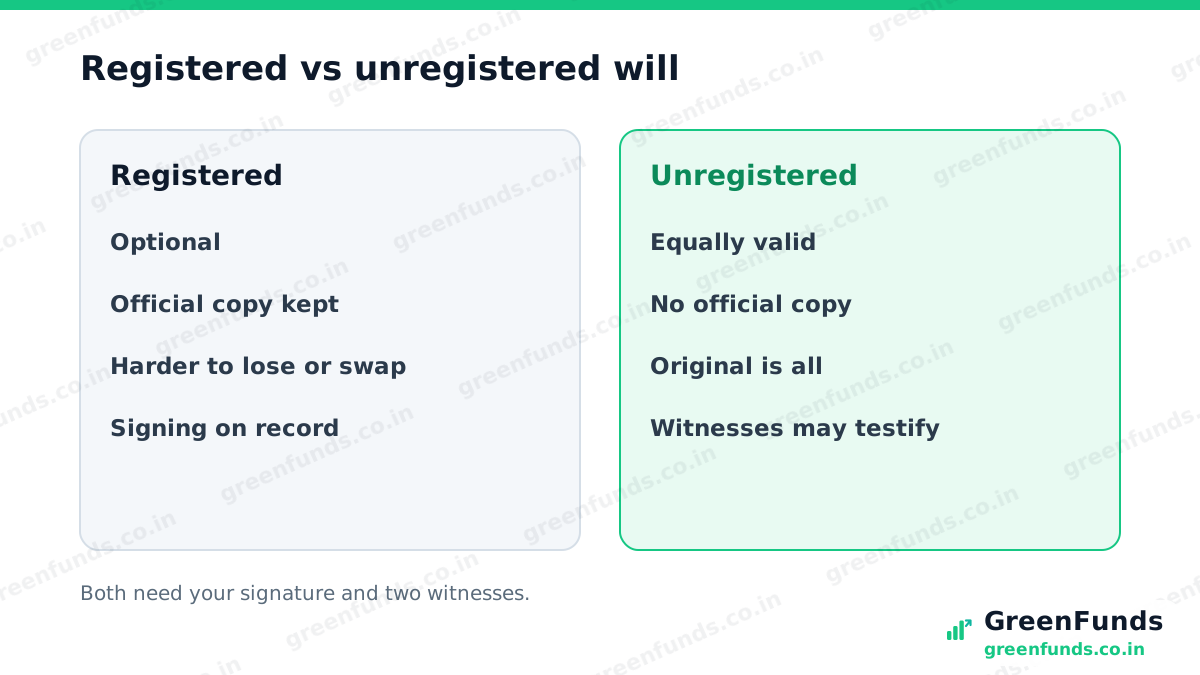
What registration does, and does not do
It does: create an official copy in the sub-registrar’s register of wills, record that you appeared and admitted signing it, and make a lost or switched will easier to deal with.
It does not: make an improperly signed or witnessed will valid, stop anyone from challenging the will in court, or replace a newer will. A later will, registered or not, can revoke an earlier registered one.
How registration works at the sub-registrar’s office

Under section 29, you can present the will at the sub-registrar’s office for the area where it was signed, or at another sub-registrar’s office in the state. Sections 34 and 35 require the registering officer to check your identity and that you admit signing the will. In practice, offices often want identifying witnesses present, and requirements differ by state, so ask your local office what it needs. Once registered, the officer endorses a certificate of registration on the will, the office copies it into its register, and the original is returned to you.
Charges. There is no national fee. Section 78 lets each state government set its own table of registration fees, so the amount depends on where you register. Your state registration department lists the current figure.
Did you know? You can also deposit your will with a Registrar in a sealed cover, without anyone reading it. Under sections 42 to 46, the Registrar logs the deposit and keeps the cover in a fireproof box. You can withdraw it at any time. After your death, an applicant can ask the Registrar to open it, and a copy is entered in the register.
Witnesses and probate, briefly
Registration sits on top of the basic rules, not in place of them. Under section 63 of the Indian Succession Act, 1925, you sign the will and at least two witnesses attest it. Probate, a court’s confirmation of a will, is no longer compulsory anywhere in India since Parliament omitted section 213 of that Act through the Repealing and Amending Act, 2025. An executor may still choose to apply.
Storing the will
Keep the original somewhere safe and known, such as a home safe or a bank locker, and give the executor a copy and the location. Review it after big life events. Keep your nominee choices in line with the will, because a nominee collects the money while the will decides who keeps it.
The takeaway. A properly signed and witnessed will is valid without registration. Registering it, or depositing it sealed, adds an official record that makes it harder to lose or dispute. Fees vary by state, and there is no deadline.
More to read: writing a will, claiming money after a parent dies, loan recovery agent rules, what to do about an income tax notice, and which ITR form to file.
-
Make the will valid first
Write the will, sign it, and have at least two witnesses attest it, as the Indian Succession Act requires. Registration does not fix a will that was not properly signed and witnessed.
-
Go to a sub-registrar's office
Take the original will to the sub-registrar for the area where it was signed, or another sub-registrar in the state where you want it registered. Carry identity proof, and check the office's own list of documents and fees.
-
Appear in person and confirm you signed it
The registering officer checks your identity and asks whether you signed the will. Many offices also want witnesses present to identify you. You pay the fee set by your state.
-
Collect the registered will and store it
The office copies the will into its register of wills and returns the original with an endorsement. Keep the original safe and tell your executor where it is.
Questions people ask
Is registration of a will compulsory in India?
No. Section 18 of the Registration Act, 1908 lists wills among documents whose registration is optional. A will that is properly signed by you and attested by two witnesses is valid whether or not it is registered.
How do I register a will in India?
Take the signed and witnessed will to a sub-registrar's office, appear in person with identity proof, confirm before the registering officer that you signed it, and pay the fee your state charges. The office records it in its register of wills and returns the original to you.
How much does it cost to register a will?
There is no single national fee. Section 78 of the Registration Act leaves registration fees to each state government, so the charge varies by state. Your state's registration department website or the local sub-registrar's office lists the current fee.
Is there a time limit for registering a will?
No. Section 27 of the Registration Act says a will may be presented for registration, or deposited, at any time. Unlike most documents, it does not have to be registered within four months of signing.
Can a will be registered after the person dies?
Yes. An executor or anyone claiming under the will can present it. The registering officer registers it if satisfied that the person who made the will signed it, that they have died, and that the person presenting it is entitled to do so.
Source: Registration Act, 1908, sections 18(e), 23, 27, 29, 34, 35, 40 to 46 and 78, as published by the Uttarakhand registration department (portal.eregistrationukgov.in); Indian Succession Act, 1925, section 63; Repealing and Amending Act, 2025 (No. 37 of 2025), Gazette of India, 21 December 2025, omitting section 213 of the Indian Succession Act.
Found this useful? You can buy us a coffee. It keeps GreenFunds free.Flag a possible issue
Was this helpful?
Thanks for the signal.
Comments
Share your experience or a question. Be kind, stay on topic. This is reader discussion, not financial advice.
No comments yet. Be the first to share.