Debt funds explained: how they earn, and the two risks to know
A fund that lends your money and earns the interest
Figures checked 2026-11-03
A debt fund is a mutual fund that lends your money. It buys bonds, which are loans to the government, banks and companies, and collects the interest they pay. That interest, plus any change in the bonds’ prices, shows up in the fund’s NAV.
Steadier, not risk-free. A debt fund doesn’t swing like a share fund, which is why people use it for money they’ll need in a few years. But two things can move it, and both are worth understanding before you put money in.
Risk one: interest rates. When rates in the market rise, new bonds pay more, so the older, lower-paying bonds a fund holds become less valuable and their prices fall. The longer a bond has left to run, the bigger the fall. The measure for this is duration, stated in years.
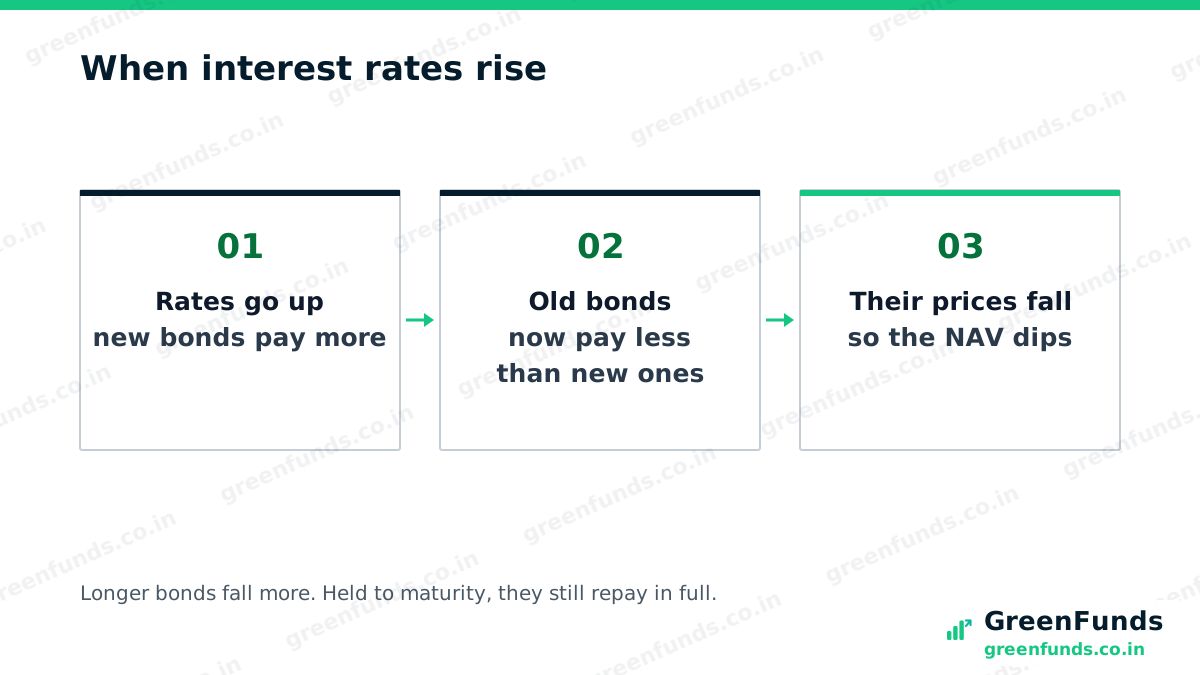
An illustration, computed: a 10-year bond paying 7% a year is worth 1,000 rupees when market rates are 7%. If rates rise to 8%, its price drops to about 933 rupees, a fall of 6.7%. A 2-year bond with the same 7% coupon falls only about 1.8%. Hold either to maturity and you still get the full 1,000 back; the dip hurts if you sell early.
Risk two: credit. Credit risk is the chance a borrower can’t repay. Government bonds carry almost none. Lower-rated company bonds pay more interest because the risk is higher, and if one defaults, the fund takes the loss. That’s what our explainer on a bond default inside your debt fund walks through.
The main kinds. SEBI sorts debt funds by how long their bonds run or what they hold.
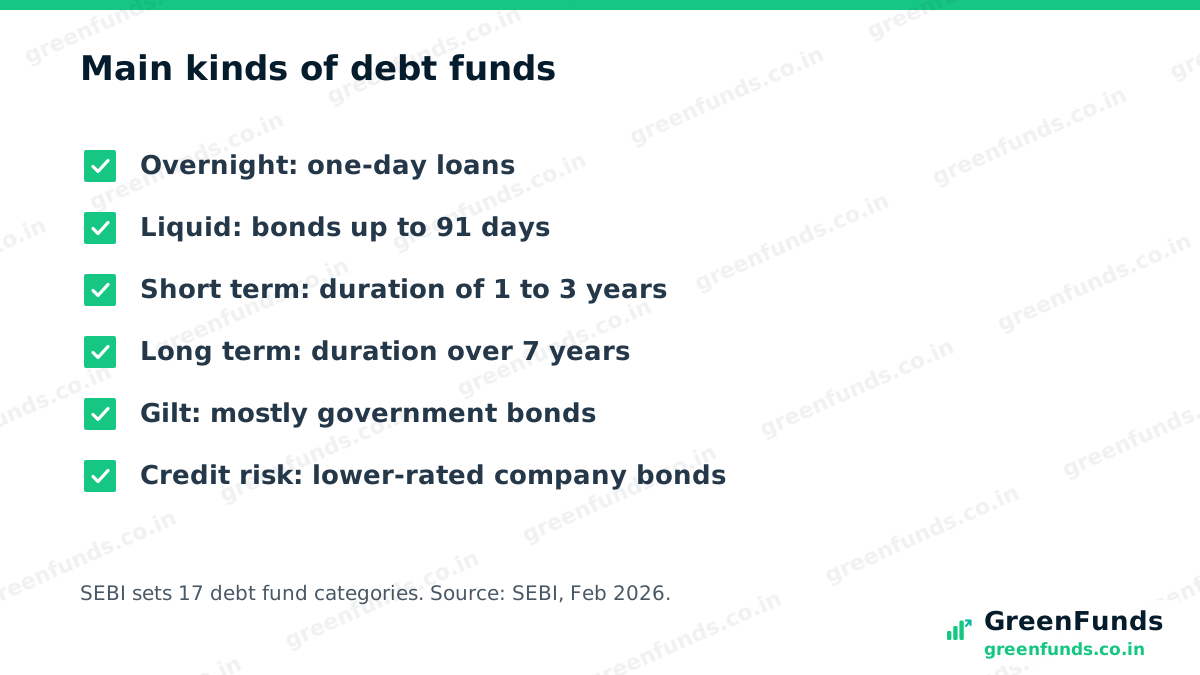
Did you know? SEBI’s February 2026 rules set 17 categories of debt fund. A gilt fund must keep at least 80% in government securities, while a credit risk fund must keep at least 65% in company bonds rated AA or lower. The name on the fund has to match its category, so the label tells you the risk.
How the gains are taxed. For units bought on or after 1 April 2023 in a fund with more than 65% in debt, gains are added to your income and taxed at your slab rate, however long you hold them. The Income-tax Act, 2025 carries this rule forward. That puts debt funds close to fixed deposits on tax, which our FD vs debt fund explainer compares.
Matching the fund to the need. Money needed in days fits an overnight or liquid fund. Money needed in a few years fits a short-duration fund. Long-duration and credit risk funds can earn more, but they swing more too. The bond’s yield to maturity shows roughly what a fund’s portfolio would earn if held to the end, before costs.
The takeaway. A debt fund earns interest by lending, and its two risks are rate moves and defaults. Duration tells you the first, credit quality the second. Gains on new units are taxed at your slab rate.
More to read: types of mutual funds, liquid funds and same-day money, and bonds and government securities, explained.
Questions people ask
What is a debt fund?
A debt fund is a mutual fund that invests mainly in bonds and other loans to governments, banks and companies. It earns the interest those borrowers pay, plus or minus changes in the bonds' prices, and passes the result on to you through the fund's NAV.
Can a debt fund lose money?
Yes. When interest rates rise, the prices of the bonds a fund already holds fall, and the NAV dips. Funds holding long bonds feel this most. And if a borrower fails to repay, the fund takes a loss on that bond. Short, high-quality funds swing least.
How are debt fund gains taxed?
For units bought on or after 1 April 2023 in a fund with more than 65% in debt, the gains are added to your income and taxed at your slab rate, however long you held them. The Income-tax Act, 2025 kept this rule.
What is duration in a debt fund?
Duration is a measure, in years, of how sensitive a fund's bonds are to interest rates. A rough rule: for every 1 percentage point rise in rates, the NAV falls by about the duration in percent. A duration of 1 year barely moves; 7 years moves a lot.
Flag a possible issue
Sources
- SEBI circular on Categorization and Rationalization of Mutual Fund Schemes, 26 February 2026 17 debt scheme categories, defined by Macaulay duration or by what they hold, for example liquid funds up to 91-day maturity, credit risk funds at least 65% in bonds rated AA and below, gilt funds at least 80% in government securities, and the new sectoral debt fund.
- Income-tax Act, 2025 (Gazette of India), definition of Specified Mutual Fund and the deemed short-term gains rule Units of a fund investing more than 65% in debt and money market instruments, acquired on or after 1 April 2023, give short-term capital gains whatever the holding period.
- RBI, Government Securities Market in India: A Primer Bond prices and yields move in opposite directions.