Money in your 20s: a checklist for the decade
Build the base in order, and let time do the heavy lifting
Figures checked 2026-11-03
Your twenties are when money habits are cheapest to build and most valuable to have. The amounts are usually small, but time is on your side, and a few early decisions shape the next thirty years. Our how to start lesson covers day one. This checklist covers the decade.
The order matters more than the amounts. Each step protects the one after it. Investing before you have a buffer means one emergency can force you to sell at a bad time. Taking on a big loan before your credit record is clean makes it cost more.

1. A simple system. Track a month of spending, then pick a plan like the 50-30-20 budget. Make saving automatic by paying yourself first on payday.
2. A buffer. Build an emergency fund of a few months of essential costs before you invest for the long term. It’s what keeps a job change or a medical bill from becoming debt.
3. Protection. Get your own health insurance rather than relying only on an employer’s cover, which can end with the job. If a parent, partner or child depends on your income, look at term insurance.
4. A clean credit record. Your first card or loan starts your credit history. Pay in full and on time, every time. Our lesson on building credit from zero shows how. Avoid expensive debt for wants, as good vs bad debt explains.
5. The investing habit. Once the first four are in place, start a regular investment, such as a monthly SIP, and raise it with every pay rise. Keep a yearly eye on your net worth, which our tracking lesson shows how to work out.
Why starting in your 20s matters. An illustration, assuming a 10% yearly return, which no investment guarantees. Invest 5,000 rupees a month from 25 to 60, and you put in 21 lakh rupees, which could grow to about 1.91 crore. Start the same 5,000 a month at 35, and you put in 15 lakh, which could grow to about 67 lakh. The extra ten years more than double the result.
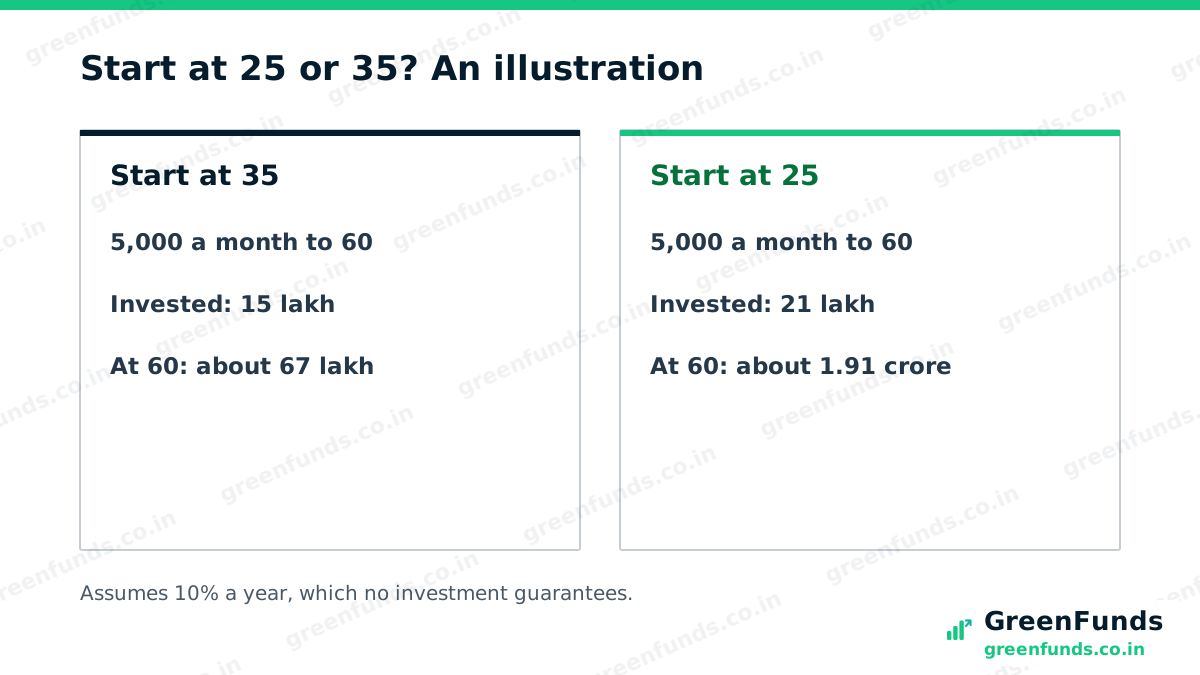
Did you know? In this illustration, the person who starts at 25 invests only 6 lakh rupees more than the one who starts at 35, but ends up with about 1.24 crore rupees more. That gap is almost entirely the extra ten years of compounding, not the extra money.
Life changes, update the plan. A new job, a move, marriage or a child changes your numbers. Revisit your budget, cover and nominees each time. Our lessons on money after marriage and setting money goals help with the next stage.
The takeaway. In your twenties, build the base in order: a system, a buffer, protection, a clean credit record, then a steady investing habit. Small amounts started early beat bigger amounts started late, because time does most of the work.
Questions people ask
What should I do with money in my 20s?
Build the base in order: a simple budget, an emergency fund, health and, if anyone depends on you, term insurance, a clean credit record, and a regular investing habit. Each step protects the next, so the order matters more than the amounts.
How much should I save in my 20s?
There's no single right number, and it depends on your income and costs. A common starting point is to move a fixed share of your take-home pay out on payday, even if it's small, and raise it every time your salary goes up.
Is it too late to start investing at 30?
No. Starting earlier gives your money more years to grow, but starting at 30 or later still works. The best time to begin is as soon as your emergency fund is in place and any high-interest debt is paid off.
How is this different from the how-to-start lesson?
The how-to-start lesson covers your first step on day one. This checklist covers the whole decade, so you know what comes next after each step and roughly when to move on to it.
Flag a possible issue
Sources
- GreenFunds illustration 5,000 rupees invested at the start of each month, at an assumed 10% a year compounded monthly, to age 60: about 1.91 crore from age 25 (21 lakh invested) and about 67 lakh from age 35 (15 lakh invested). Not a forecast of any real return.