Drawing income in retirement: turning savings into a monthly pay
Mix steady income for the basics with slower-growing money for later years
Figures checked 2026-11-03
Retirement flips the money question. For decades it was how to build a pile. Now it’s how to turn that pile into a monthly income that lasts as long as you do, without running out in your eighties. There’s no single right product. Most retirees mix a few, each doing a different job.
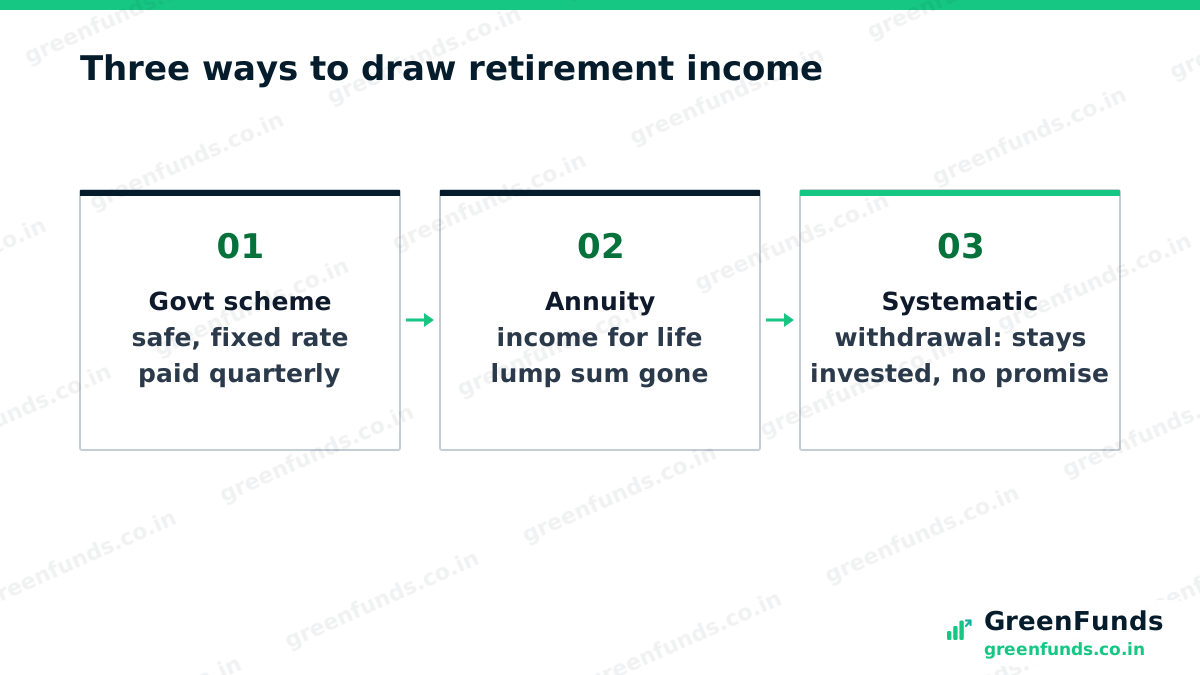
Job 1: steady income for the basics. Rent, food, bills and medicines need money every month, whatever the markets do. Government schemes and annuities fit here.
- The Senior Citizen Savings Scheme takes up to 30 lakh rupees per person and pays interest every quarter. India Post lists it at 8.2% a year. An illustration: 30 lakh rupees pays 61,500 rupees a quarter.
- An annuity turns a lump sum into a fixed income, often for life. The trade-off is that you usually can’t get the lump sum back.
Job 2: money that keeps growing for later years. Retirement can last 25 years or more, and prices keep rising the whole time. Part of your corpus usually needs to stay in growth assets, drawn on through a systematic withdrawal plan, or SWP, which sells a set amount of your mutual fund each month.
The NPS exit rules, as they stand. If you have an NPS account, PFRDA’s exit rules as amended in December 2025 apply. For most non-government subscribers at 60, at least 20% of the pot must buy an annuity and the rest can come as a lump sum or instalments. A pot of 8 lakh rupees or less can be taken in full. Between 8 and 12 lakh, up to 6 lakh can be a lump sum, with the rest paid over at least six years or as an annuity. You can also defer until 85. An illustration: on a 20 lakh rupee pot, at least 4 lakh must buy an annuity, and up to 16 lakh can come out as a lump sum or instalments.
Did you know? PFRDA’s latest change to the NPS exit rules, in July 2026, didn’t touch these percentages. It only changed how pension funds can offer services through other entities. The 20% minimum annuity for most non-government subscribers dates from the December 2025 amendment.
Why the withdrawal rate matters most. How much you take out each year decides how long the money lasts. A simple illustration: a 1 crore rupee corpus earning an assumed 7% a year, with withdrawals rising 6% a year for inflation.
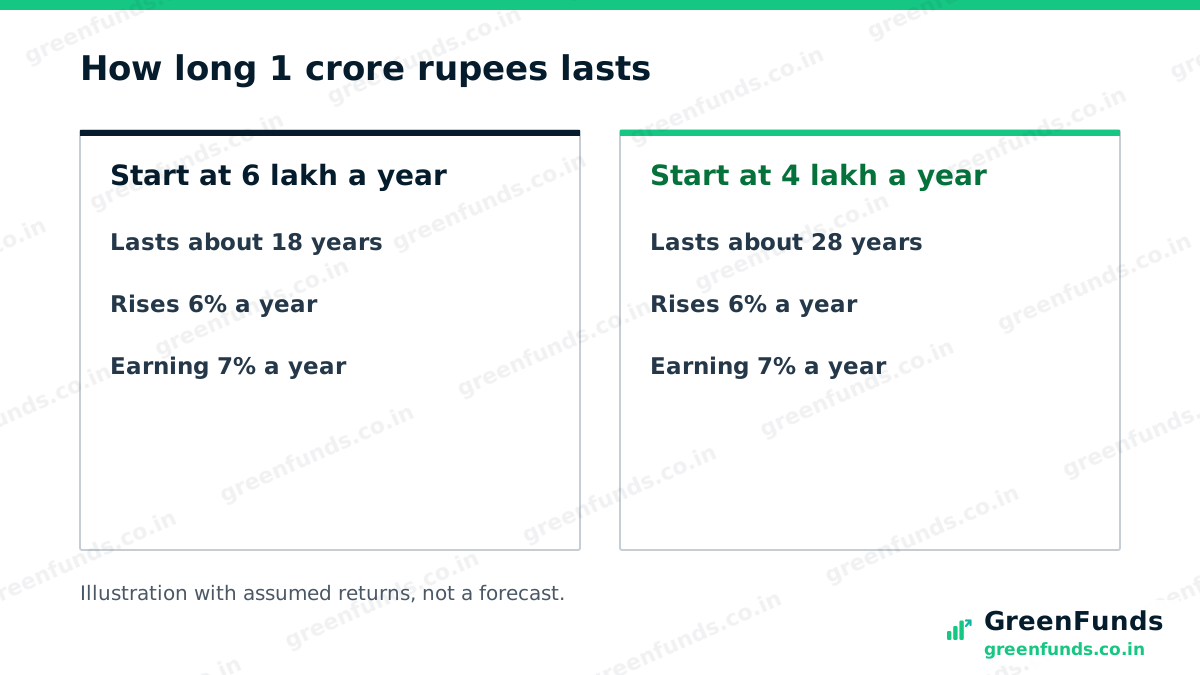
Starting at 4 lakh rupees, it covers about 28 years. Starting at 6 lakh, about 18. That gap is why the withdrawal rate is the number to watch, and why our lesson on how much you need to retire starts from your yearly spending.
Keep a buffer. Many retirees keep a year or two of spending in a safe place, so a market fall doesn’t force them to sell growth assets at a low price. Our lesson on asset allocation explains the mix.
The takeaway. Use safe income for the basics, keep part of the money growing for later years, and keep the withdrawal rate modest. Review it every year, because your spending, health and returns will all change.
More to read: retirement planning, how much you need to retire, and caring for ageing parents.
Questions people ask
What is a safe withdrawal rate in retirement?
There's no single safe number, because it depends on your returns, inflation and how long you live. The idea is to take a share of your corpus each year that it can sustain. In our illustration, a 1 crore rupee corpus earning 7% a year covers a 4 lakh rupee first-year withdrawal, rising 6% a year, for about 28 years. Starting at 6 lakh, it lasts about 18.
How much of my NPS must buy an annuity?
For most non-government subscribers exiting at 60 or after 15 years, at least 20% of the pot must buy an annuity, and the rest can be taken as a lump sum or in instalments. If the pot is 8 lakh rupees or less, you can take it all. Between 8 and 12 lakh, up to 6 lakh can be a lump sum and the rest is paid out over at least six years or as an annuity. These are PFRDA's exit rules as amended in December 2025.
What is the difference between an annuity and a systematic withdrawal?
An annuity is bought from an insurer with a lump sum and pays you a fixed income, often for life, but you usually can't get the lump sum back. A systematic withdrawal plan takes a set amount from your own mutual fund investment each month, so the money stays yours and can grow, but the income isn't guaranteed and the pot can run down.
Can I keep my NPS invested after 60?
Yes. PFRDA's rules let a subscriber defer buying the annuity or taking the lump sum up to age 85, and exit at any point during that time.
Flag a possible issue
Sources
- PFRDA (Exits and Withdrawals under the NPS) Regulations, 2015, as last amended on 16 December 2025, regulation 4 (non-government subscribers) At 60, after 15 years or on superannuation: at least 20% to an annuity, the rest as lump sum or periodic payouts. Pot up to 8 lakh: all can be withdrawn. 8 to 12 lakh: up to 6 lakh lump sum, rest as periodic payouts for at least six years or an annuity. Deferral up to age 85.
- PFRDA (Exits and Withdrawals under the NPS) (Amendment) Regulations, 2026 (Gazette, 14 July 2026) Amends regulation 4A only (services through other entities); the exit percentages above are unchanged. PFRDA's regulations page lists this as the latest amendment, issued 20 July 2026.
- India Post, Post Office Savings Schemes brochure and rates page (updated 30 October 2026) Senior Citizens Savings Scheme: 8.2% a year, interest paid quarterly, up to 30 lakh rupees across accounts, 5 years renewable in 3-year terms. Monthly Income Scheme: 7.4% a year, paid monthly.
- Worked illustration 1 crore rupee corpus earning an assumed 7% a year; withdrawals at the start of each year rising 6% a year. 4 lakh rupees first year: fully covered for 28 years. 6 lakh: 18 years. Computed year by year; assumptions, not forecasts.