Teaching kids about money: simple steps by age
Let children practise with small, real money long before the stakes are big
Figures checked 2026-11-03
Children learn about money mostly by handling it. Talks help, but a child who has spent their own pocket money on something disappointing learns more than any lecture can teach. The goal is simple: give them small, real money and real choices, early, while the stakes are tiny.
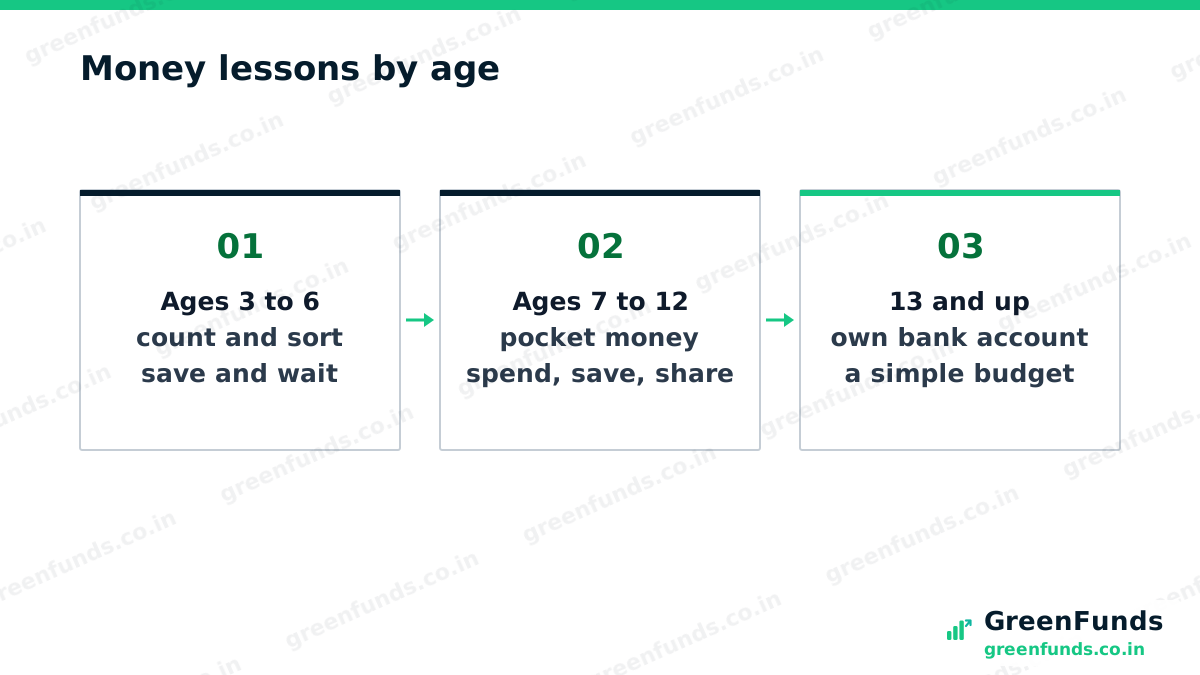
Ages 3 to 6: counting and waiting. Coins and notes are just objects at first. Let them count, sort and pay at a shop counter. The bigger lesson at this age is waiting: saving up for a small toy in a clear jar, where they can see the pile grow, shows that money now can become something better later.
Ages 7 to 12: pocket money as practice. A small, regular amount turns choices into lessons. Split it into a few pots: some to spend, some to save, some to share. Then let them choose, and let some choices go wrong. Buying the cheap toy that breaks in a week is a cheap lesson in needs versus wants.
An illustration: 500 rupees a month of pocket money with 20% set aside is 100 rupees a month, or 1,200 rupees by the end of the year. Seeing that number grow does more than explaining it.
Ages 13 and up: a real account. This is the age for a bank account in the child’s own name, with a debit card if the bank offers one, and a simple monthly budget for things like phone recharges or outings. Talk through the UPI PIN rule early: a PIN is only ever entered to pay, never to receive.
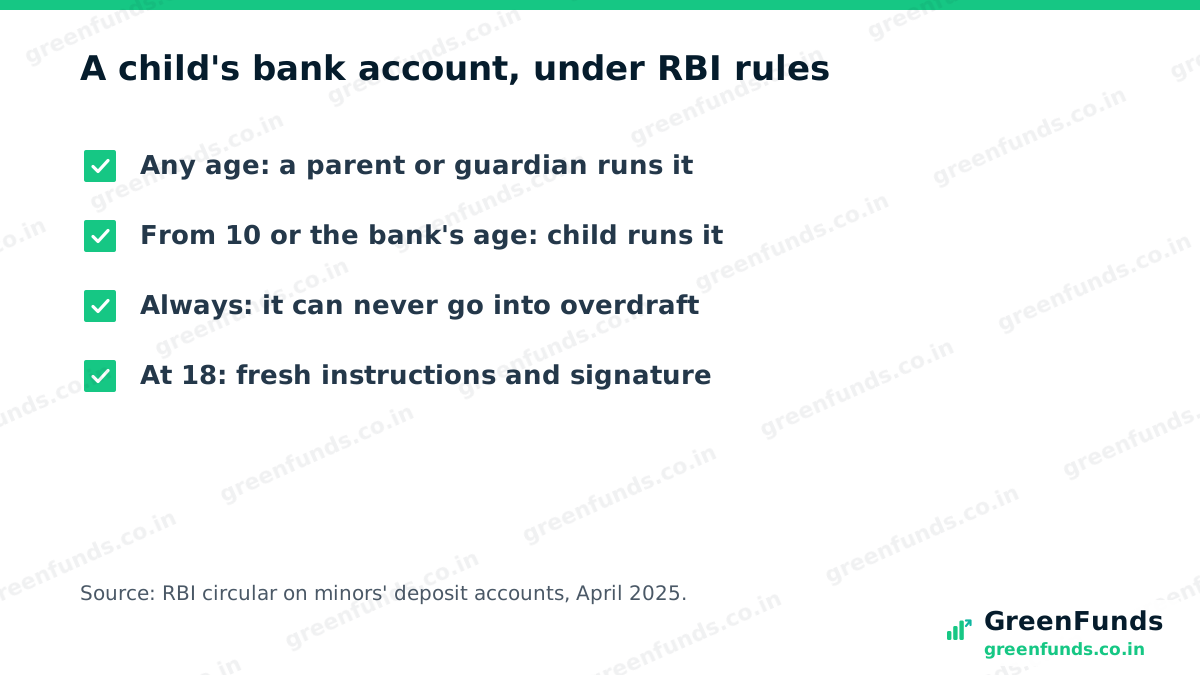
Did you know? Under RBI’s April 2025 rules, a minor account can be run by a parent or guardian at any age, including with the mother as guardian, and banks can let a child operate their own account from an age they set, but not below 10. These accounts can never go into overdraft, so a child can’t spend money that isn’t there.
What the bank rules mean for you. Each bank sets its own age limit and amount limits for a child running an account independently, so ask your bank. When the child turns 18, the bank takes fresh instructions and a new signature from them. Our guide to bank accounts covers the account types.
Talk about your own choices. Children copy what they see. Saying out loud why you’re waiting for a sale, or why you said no to something, shows how money decisions actually get made. A simple budget shared at the dinner table is a lesson in itself.
The takeaway. Start small and start early: counting and waiting first, then pocket money with real choices, then an account of their own. The mistakes they make with 100 rupees now are the ones they won’t make with a salary later.
More to read: planning for your child’s education, needs versus wants, and safe habits on UPI.
Questions people ask
At what age can a child open a bank account in India?
A child of any age can have a savings or term deposit account opened and run by a parent or legal guardian, and the mother can be the guardian. From an age the bank sets, which can't be lower than 10, a child can be allowed to open and operate an account on their own, within limits the bank fixes. These rules come from RBI's April 2025 circular on minors' accounts.
Can a minor's bank account go into overdraft?
No. RBI's rules say a minor's account, whether run by the child or a guardian, must never be overdrawn and must always stay in credit. Banks may offer extras like a debit card or internet banking, based on their own risk policy.
Should pocket money be tied to chores?
Families do it both ways. A fixed allowance teaches budgeting, because the amount is predictable. Paying for extra jobs teaches that money comes from work. Many parents use a small fixed amount plus a little for extra tasks. What matters most is letting the child make the spending choices, including some mistakes.
What happens to a minor's account when the child turns 18?
The bank takes fresh operating instructions and a new specimen signature from the account holder. If a guardian ran the account, the balance is confirmed with the now-adult account holder. RBI asks banks to tell minors about this in advance.
Flag a possible issue
Sources
- RBI, Opening of and operation in deposit accounts of minors (RBI/2025-26/26, 21 April 2025) Minors of any age through a natural or legal guardian, including the mother; independent operation from an age set by the bank, not below 10; never overdrawn; fresh instructions and signature at majority; banks to align policies by 1 July 2025.
- Worked illustration 500 rupees a month of pocket money, with 20% set aside, is 100 rupees a month, or 1,200 rupees in a year. Simple arithmetic; an example, not a recommendation.