Pay yourself first: automate your saving
Move savings out on payday, before you can spend them
Figures checked 2026-11-03
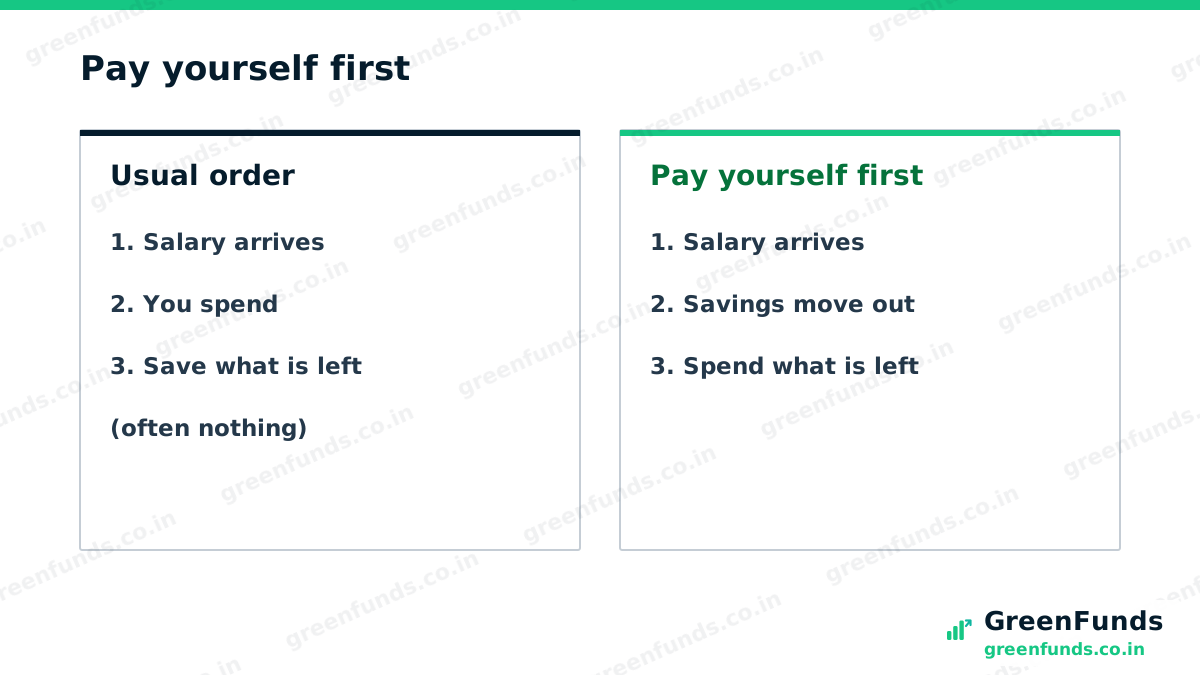
Most people save whatever is left at the end of the month. The trouble is that there’s rarely much left. Paying yourself first flips the order: your savings leave your account on payday, and you live on the rest.
Why the order matters. Money sitting in your spending account tends to get spent. Moving the saving out first takes the decision away from you on the days you’re tired or tempted. You don’t need more willpower, just a different order.
An illustration. On a take-home salary of 40,000 rupees, you set 20% to move out on payday. That’s 8,000 rupees a month, or 96,000 rupees a year, saved without a single monthly decision. You then plan your month around the 32,000 that’s left, using a guide like the 50-30-20 budget.
Way 1: a standing instruction. A standing instruction tells your bank to move a fixed amount on a fixed date, for example to a separate savings account, a recurring deposit or a sinking fund. You set it once in net banking or at the branch.
Way 2: an e-mandate or auto-debit. An e-mandate lets a company pull a fixed payment from your card or UPI on a schedule, with your one-time approval. A monthly SIP commonly runs on a bank mandate in the same way: you register it once and the amount is debited on your chosen date.
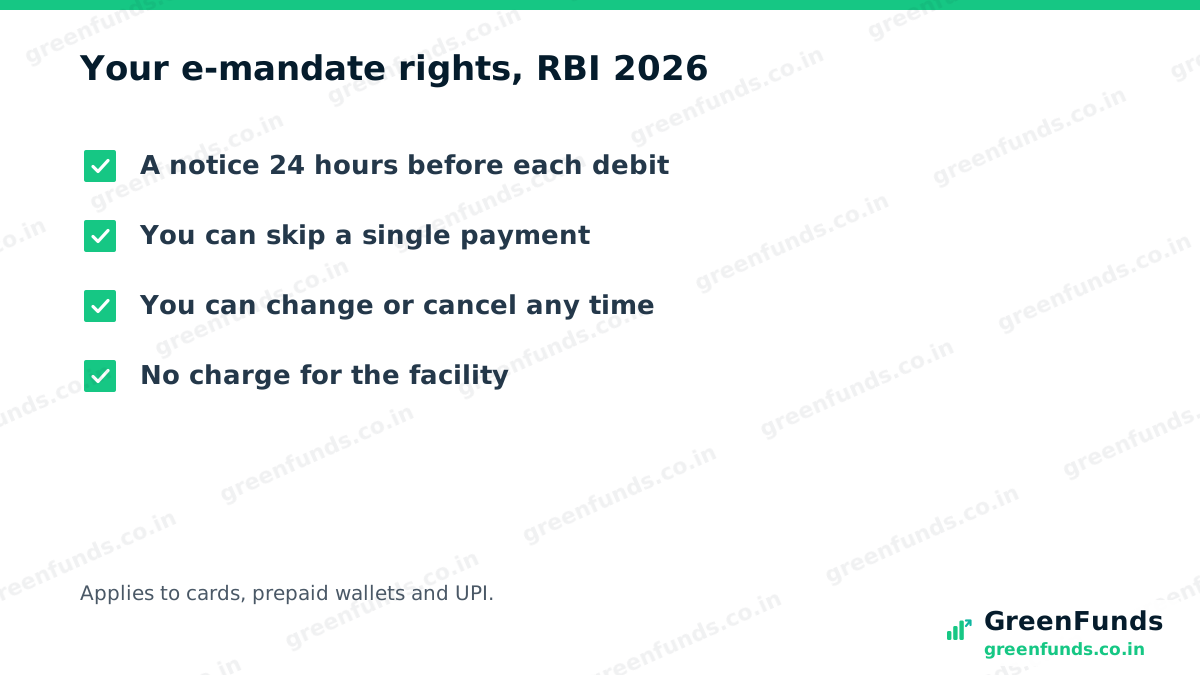
What RBI’s 2026 rules give you. Under the E-mandate Framework, 2026, for recurring payments on cards, prepaid instruments and UPI:
Did you know? After your first e-mandate payment, later debits up to 15,000 rupees go through without an OTP. For insurance premiums, mutual fund investments and credit card bills, that limit is 1 lakh rupees, per RBI’s April 2026 framework. Anything above needs your approval each time.
Set it up in three steps. First, pick the amount: start smaller than feels comfortable, and raise it after a few months. Second, pick the date: a day or two after your salary usually lands, so the debit never bounces. Third, pick the destination: your emergency fund first, then goals.
The takeaway. Make saving the first payment of the month, not the last. A standing instruction or an e-mandate does it for you, and RBI’s rules mean you’re warned before each debit and can stop it any time. Start small, then raise it as your income grows.
More to read: tracking your spending and net worth, SIP vs lump sum, and setting money goals.
Questions people ask
What does pay yourself first mean?
It means setting aside your savings as soon as your salary arrives, before you pay for anything else, and then living on what remains. Instead of saving whatever is left at the end of the month, which is often nothing, saving becomes the first bill you pay.
How do I automate my savings?
Two common ways: ask your bank for a standing instruction that moves a fixed amount to another account or a recurring deposit on a set date, or register an e-mandate or auto-debit for something like a SIP. Set the date a day or two after your salary usually arrives.
Will I be told before an auto-debit happens?
For e-mandates on cards, prepaid instruments and UPI, yes. Under RBI's E-mandate Framework, 2026, your bank or app must notify you at least 24 hours before each debit, with the merchant, amount and date, and let you opt out of that particular payment.
Can I cancel an auto-debit?
Yes. RBI's 2026 framework requires the issuer to let you change the validity of an e-mandate or withdraw it at any time, with an extra authentication step such as an OTP. The facility itself must be free of charge.
Flag a possible issue
Sources
- RBI, Digital Payments: E-mandate Framework, 2026, 21 April 2026 (RBI/DPSS/2026-27/396) Covers recurring transactions on cards, prepaid instruments and UPI. Pre-debit notice at least 24 hours ahead with an opt-out; no extra authentication up to Rs 15,000 per debit, or Rs 1 lakh for insurance premiums, mutual fund subscriptions and credit card bills; withdrawal or change at any time; no charge for the facility.