Building a credit history from zero
Lenders trust a track record, so start a small one and keep it clean
Figures checked 2026-11-03
A credit history is your record of borrowing and repaying. Lenders read it before giving you a loan or a card. If you’ve never borrowed, there’s no record at all, and that’s the problem: you’re not a bad risk, just an unknown one.
Why a blank record matters. Your credit score is worked out by a credit bureau from your credit history. With no history, there’s nothing to score. When you later need a home loan or a bigger card, a thin file can mean a slower decision or a less friendly rate.
Step 1: open one small, easy line of credit. The common first step is a secured card, a credit card issued against a fixed deposit you keep with the bank. Your FD backs the card, so banks issue it even without a history. A small consumer loan you were going to take anyway also counts, as long as you repay every EMI on time.
Step 2: use it lightly, pay it fully. An illustration: on a card with a 40,000 rupee limit, put 4,000 rupees of regular spends on it, like a phone bill and groceries, and pay the full bill by the due date. Paying only the minimum keeps the record clean but piles up interest, as our guide to the minimum due trap shows.
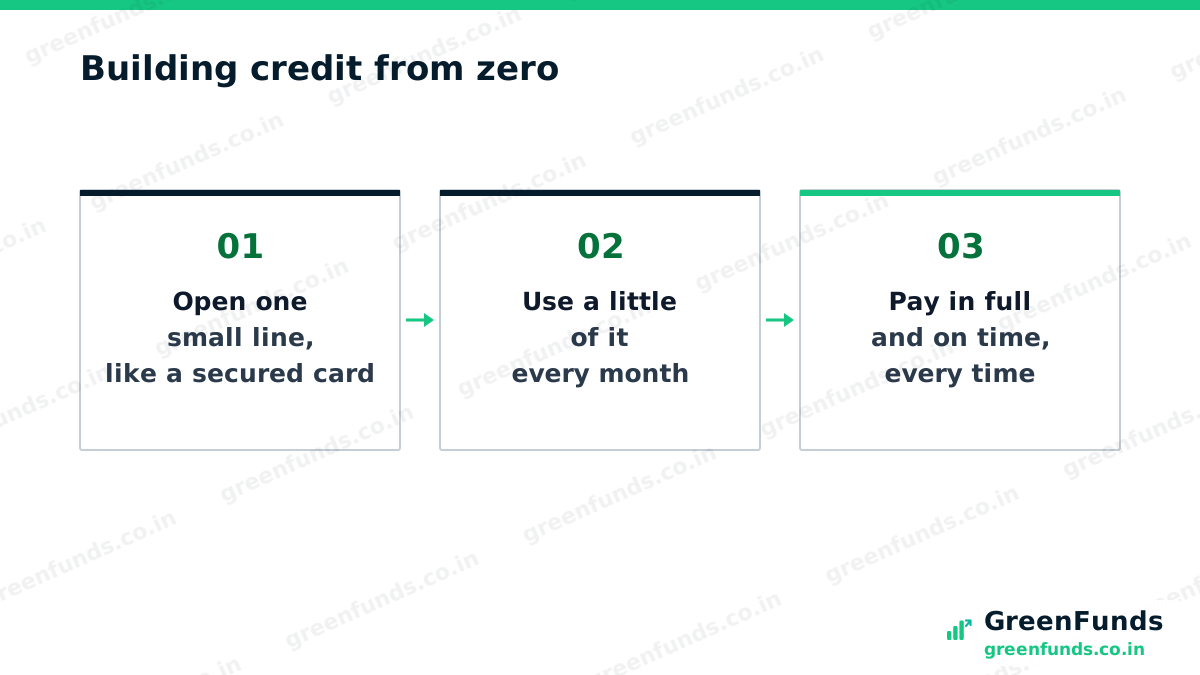
Step 3: give it time. A history is built from many on-time months, not one. Avoid applying for several cards or loans at once while you’re starting: each application shows up as an enquiry on your report.
Did you know? Since an RBI circular of October 2023, credit bureaus must send you an SMS or email whenever your credit report is accessed, and lenders must alert you when they report a missed payment. From 1 July 2026, banks also report to bureaus on four dates a month instead of two, so your record catches up within weeks.
Step 4: check your report once a year. RBI requires every credit bureau to give you one free full credit report, including your score, each year. Look for accounts you don’t recognise and payments wrongly marked late. Our step-by-step guide to checking your credit report shows how.

The takeaway. Start with one small line of credit, use a little of it, pay it in full and on time, and give it time. Check your free report every year. A clean record built in your twenties makes every bigger loan later easier and cheaper.
More to read: your credit score, explained, how to improve your credit score, and activating your first credit card.
Questions people ask
Why do I have no credit score?
A credit score is worked out from your borrowing record held by credit bureaus. If you've never had a loan or credit card, there's no record to score, so you may show as having no history. That isn't a bad mark, but it gives lenders nothing to go on.
What is the easiest way to start a credit history?
Many people start with a secured credit card, issued against a fixed deposit you keep with the bank. Use it for small, regular spends and pay the full bill by the due date every month. Each on-time payment adds to your record.
How quickly does a payment show up on my credit report?
Faster than it used to. Under RBI directions in force from 1 July 2026, banks submit a full file to credit bureaus as on the last day of each month and updates as on the 9th, 16th and 23rd, each within a few days. So changes reach your record within weeks, not months.
Can I check my credit report for free?
Yes. RBI requires every credit bureau to give individuals one free full credit report, including the credit score, once a year on request. Since there are several bureaus, you can check each of them.
Flag a possible issue
Sources
- RBI (Commercial Banks, Credit Information Reporting) Amendment Directions, 2025, 4 December 2025 (RBI/DOR/2025-26/110), in force from 1 July 2026 Full file as on the last day of the month, submitted by the 5th of the next month; incremental accounts as on the 9th, 16th and 23rd, within four calendar days.
- RBI press release 2025-2026/1626, 4 December 2025 Existing rules required submission at fortnightly or shorter intervals; the amendments move to weekly incremental submission.
- RBI, Strengthening of customer service rendered by Credit Information Companies and Credit Institutions, 26 October 2023 (RBI/2023-24/73) Credit bureaus must alert customers by SMS or email when their credit report is accessed; lenders must alert customers when reporting a default or days past due.
- RBI directive on free full credit report, 1 September 2016 (DBR.CID.BC.No.10/20.16.042/2016-17) One free full credit report, including the credit score, once in a calendar year from each credit bureau, effective 1 January 2017.